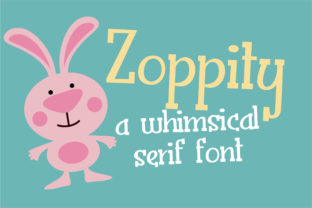
Zoppity: A Whimsical Serif Font for Creative Expression
Zoppity is a distinctive serif font designed to bring charm and personality to visual communication. It’s not a neutral workhorse typeface—nor does it aim to be. Instead, Zoppity leans into its own character: playful curves, expressive contrast, and subtle irregularities that evoke hand-drawn warmth without sacrificing readability. Its letterforms balance structural integrity with gentle unpredictability—a lowercase g with a looping tail, an uppercase R with a curving leg, and serifs that taper like brushstrokes rather than rigid slabs.
What Sets Zoppity Apart From Other Serifs
Most serif fonts fall into broad categories: traditional (like Times New Roman), transitional (such as Baskerville), modern (e.g., Didot), or slab-serif (like Rockwell). Zoppity doesn’t neatly fit any of those. It’s best understood as a *whimsical serif*—a small but growing category where typographic personality takes center stage. Unlike high-contrast modern serifs that emphasize elegance through precision, or sturdy slab-serifs built for clarity at scale, Zoppity prioritizes mood and approachability.
This distinction matters in practice. When selecting a font for a children’s book illustration, a boutique bakery’s packaging, or a creative studio’s identity system, tone often carries more weight than strict neutrality. Zoppity communicates friendliness and imagination without needing supporting imagery. That’s not something a standard Garamond or Georgia can reliably deliver—even if those fonts are more versatile across long-form text.
Where Zoppity Fits in Real-World Projects
Zoppity shines in contexts where voice and visual rhythm matter more than sheer legibility at small sizes. Consider these examples:
- A stationery brand using Zoppity for product names and greeting card headlines—its warmth reinforces the tactile, personal nature of paper goods.
- An indie podcast about storytelling pairing Zoppity with a clean sans-serif (like Inter or Lato) for titles and episode art—creating contrast while keeping the overall feel inviting and human-centered.
- A local theater group choosing Zoppity for posters and social media banners—its bold yet friendly presence helps convey energy and accessibility without veering into cartoonishness.
In each case, Zoppity isn’t doing heavy lifting for body copy. It’s functioning as a design accent: reinforcing brand values, guiding attention, and adding emotional texture. That’s a strategic use—not a limitation.
Tradeoffs to Consider Before Choosing Zoppity
No font excels in every scenario, and Zoppity is no exception. Its strengths—expressiveness, distinct rhythm, whimsy—are also its constraints. Because of its moderate stroke contrast and slightly condensed proportions, Zoppity performs less effectively in extended reading settings. You wouldn’t want it for a 50-page annual report or a dense blog post. Similarly, its personality may clash with industries where formality, authority, or technical precision are expected—think legal documentation, academic journals, or enterprise software interfaces.
Another practical consideration is language support. While Zoppity includes standard Latin characters and common diacritics (á, ñ, ü), it doesn’t extend to Cyrillic, Greek, or extended Vietnamese character sets. If your project targets multilingual audiences beyond Western European languages, you’ll need to verify coverage—or plan for fallback fonts.
Finally, licensing is worth checking early. Zoppity is available under both free and premium licenses, depending on usage scope. Personal projects and small websites often qualify for the free version, but commercial applications—especially those involving merchandise, apps, or SaaS platforms—may require a paid license. Always review the terms before integrating it into production assets.
How Zoppity Compares With Similar Approaches
Designers sometimes reach for handwritten or display fonts when they want “personality.” But Zoppity offers a middle ground: more structured than a script font, more animated than a classic serif. Compared to popular alternatives like Playfair Display or Merriweather, Zoppity trades historical gravitas for contemporary playfulness. Where Playfair conveys editorial sophistication, Zoppity suggests curiosity and craft.
It also differs meaningfully from decorative serifs like Bodoni Poster or Staatliches. Those fonts lean heavily into retro or geometric stylization—often at the expense of subtlety. Zoppity feels more integrated, more intentional in its irregularities. Its quirks don’t distract; they invite closer looking.
That said, if your goal is maximum flexibility—pairing one font family across headings, subheads, captions, and paragraphs—Zoppity isn’t built for that role. It lacks extensive weights (no light, extra-bold, or condensed variants) and has limited optical sizing. You’ll likely pair it with a complementary sans-serif or neutral serif for body text, which is perfectly fine—and in fact, quite common among thoughtful typographic systems.
When Zoppity Is Likely the Right Choice
Zoppity fits best when three conditions align:
- You’re prioritizing tone over neutrality. If your message benefits from warmth, creativity, or gentle irreverence, Zoppity supports that intention directly.
- The application is visual-first and relatively short-form. Logos, posters, invitations, app splash screens, and social graphics all benefit from its focused impact.
- You have control over pairing and hierarchy. Zoppity works well when paired intentionally—not as a standalone solution, but as part of a considered typographic strategy.
It’s also a strong candidate if you’re working within tight creative constraints—say, a single-color print job or a low-resolution digital banner—where distinctive letterforms help carry visual interest without relying on complex graphics.
When Another Option Might Serve Better
If your project demands high legibility at small sizes—think mobile UI labels, footnotes, or data tables—Zoppity’s stylistic details may hinder quick scanning. In those cases, a highly legible serif like Charter or a robust sans-serif like Open Sans would be more functionally appropriate.
Similarly, if your brand guidelines require strict consistency across global markets—including non-Latin scripts—you’ll need broader-coverage type families. Zoppity’s current scope makes it better suited for English-dominant or Western European-facing work.
And if your team lacks typography experience, Zoppity’s uniqueness can backfire without careful implementation. Without thoughtful spacing, size scaling, and pairing, it risks feeling unpolished rather than charming. In those situations, starting with a more forgiving, widely tested font—and gradually introducing expressive accents—may yield more reliable results.
Making a Practical Decision
Choosing Zoppity isn’t about finding the “best” font—it’s about matching typographic behavior to communication goals. Ask yourself: What emotion should this text evoke? How much space does it occupy visually? Who will read it, and under what conditions?
If Zoppity’s blend of whimsy and structure aligns with your answers, test it early—not just in mockups, but in real context. Try it at actual sizes on target devices. Print a sample. See how it holds up next to photography or illustrations. Compare it side-by-side with two alternatives: one more neutral, one more exaggerated. Notice where it gains or loses clarity, charm, or confidence.
Typography is rarely about perfection. It’s about resonance. Zoppity resonates when authenticity, joy, and craftsmanship are part of the message—not just the medium. Used thoughtfully, it adds dimension. Used without intention, it can dilute focus. Like any expressive tool, its value lies not in its features alone, but in how deliberately it’s applied.