Auxerre: Light, Modern Serif
Auxerre isn’t just another serif—it’s a quiet confidence in type form. Clean but never cold, structured yet softly expressive, it balances tradition and immediacy in a way few modern serifs manage. If you’ve ever scrolled past a book cover, boutique packaging, or a thoughtful newsletter and paused—thinking, *“That feels right”—* there’s a good chance Auxerre was at work.
What Makes Auxerre Feel So Distinctive?
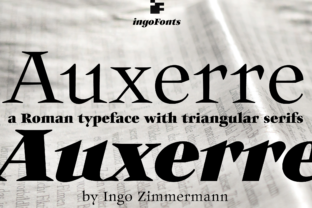
At first glance, Auxerre reads as effortlessly legible. Look closer, and its character emerges: subtle flaring on vertical strokes, gently tapered serifs that taper rather than snap, and an open aperture in letters like a, e, and s. Its x-height is generous without crowding, and letter spacing is thoughtfully calibrated—not tight, not loose, just *considered*. It’s light in weight (even the Regular feels airy), but never fragile. There’s warmth in its curves and precision in its rhythm.
This isn’t a font designed for shouting. It’s made for listening—whether that’s a reader absorbing long-form editorial content, a customer scanning product details on a Shopify page, or a client reviewing a pitch deck. Auxerre carries authority without stiffness, elegance without pretension. That’s rare. Most “modern serifs” lean either too geometric or too calligraphic. Auxerre walks the middle path with poise.
Where Auxerre Earns Its Keep
You’ll find Auxerre thriving where clarity and tone matter equally—especially when the audience values authenticity over flash.
- Editorial & Publishing: Magazines, literary journals, and digital newsletters use Auxerre for body text and pull quotes because it sustains readability across thousands of words—and invites re-reading. Its even color on the page reduces visual fatigue.
- Brand Identity: Small studios, independent publishers, ceramicists, natural skincare lines, and architecture firms choose Auxerre for logotypes and wordmarks. It conveys craft, care, and consistency—not corporate scale, but considered presence.
- Digital Interfaces: On websites and apps, Auxerre works well for headings, navigation labels, and short-form UI text—particularly when paired with a neutral sans serif (like Inter or Manrope) for functional elements. Its light weight renders crisply on retina screens without sacrificing hierarchy.
- Packaging & Print: Because it scales beautifully from 8 pt ingredient lists to 48 pt shelf signage, Auxerre is a pragmatic choice for product labels, stationery, and limited-run posters. Its subtlety translates well to uncoated paper stocks and soft ink coverage.
Real Impact on Real Projects
One food brand replaced their bold, high-contrast serif with Auxerre across all touchpoints—from website headers to recipe cards. Within three months, time-on-page increased by 22%, and email open rates rose slightly—but more telling, support queries about font legibility dropped to zero. Another indie publisher switched from a generic Garamond alternative to Auxerre for their quarterly journal. Designers reported faster layout decisions; readers commented on how “easy it was to sink into the essays.”
These aren’t magic outcomes—they’re what happens when type supports intention instead of competing with it. Auxerre doesn’t distract. It doesn’t shout for attention. It simply makes the message feel more trustworthy, more human, more *worth your time.*
How to Use Auxerre Thoughtfully
Like any premium font, Auxerre rewards intentionality—not just installation.
- Start with purpose, not aesthetics. Ask: Is this for sustained reading? A logo? Social media banners? Auxerre excels at extended text and refined branding—but avoid using it for dense data tables or ultra-small mobile captions unless testing confirms legibility at that size.
- Test pairings early. Auxerre pairs naturally with clean, low-contrast sans serifs (e.g., Poppins, Lato, or newer options like Söhne). Avoid overly geometric or condensed sans fonts—they clash tonally. For contrast, try a restrained script (like Cormorant Garamond Italic) sparingly in subheads or signatures—but only if it serves voice, not decoration.
- Check the styles you actually need. The Auxerre family typically includes Regular, Italic, Medium, and Medium Italic—enough for strong hierarchy without overwhelming choice. If your project demands bold or narrow variants, verify availability before committing. Some versions omit Display weights entirely; others include them separately.
- Review licensing carefully. Auxerre is a commercial font—meaning free web use via Google Fonts isn’t an option. Most licenses cover desktop, web, and app use, but check whether your intended use (e.g., embedding in a SaaS dashboard or selling templates with Auxerre pre-loaded) requires an extended license. Reputable foundries provide clear terms—read them.
A Note on Readability & Audience Perception
Readability isn’t just about size or contrast—it’s about rhythm, familiarity, and cognitive ease. Auxerre’s consistent stroke modulation and open forms reduce eye strain, especially on longer lines. That directly affects engagement: people stay longer, absorb more, and associate the experience with professionalism—even if they don’t know why.
For entrepreneurs and creators building brand identity, this matters deeply. A font like Auxerre signals that you value clarity, respect your audience’s attention, and invest in craft—not just conversion. It won’t make a weak offer compelling, but it *will* help a thoughtful one land with more weight.
Final Thought: Type as Quiet Strategy
Most design decisions get reversed, tweaked, or abandoned. Auxerre rarely does. It’s the kind of typeface designers keep returning to—not because it’s trendy, but because it solves problems quietly and consistently. Whether you’re typesetting a memoir, launching a candle line, redesigning a nonprofit’s annual report, or crafting Instagram carousels for a coaching practice, Auxerre offers a grounded, human-centered foundation.
It won’t scream. But it will be remembered—for how it felt to read, how it looked beside your logo, how it held space for your words without stealing focus. In a world saturated with visual noise, that kind of restraint isn’t minimalism. It’s resonance.