Squeeze of Lime: A Handwritten Font with Playful Personality
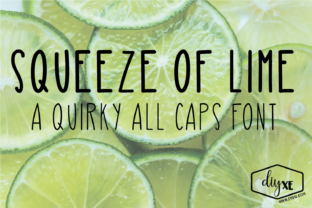
Squeeze of Lime is a distinctive handwritten typeface designed to convey spontaneity, humor, and approachability. Unlike many script fonts that aim for elegance or calligraphic precision, Squeeze of Lime leans into intentional irregularity—uneven letter heights, exaggerated swashes, inconsistent stroke weights, and subtle wobbles that mimic the natural rhythm of quick pen-on-paper writing. It’s not “perfectly imperfect” in a curated way; it feels genuinely unpolished, like a note passed across a desk during a lighthearted meeting.
What Makes Squeeze of Lime Stand Out
The font’s character stems from its deliberate quirks: letters occasionally overlap, some lowercase i dots tilt or float slightly off-center, and certain characters—like the g or y—feature extended, looping descenders that add visual energy. These aren’t bugs; they’re features baked into the design to reinforce a sense of immediacy and levity. The spacing between letters is intentionally loose and variable, avoiding mechanical uniformity. That looseness gives Squeeze of Lime breathing room on screen and in print—but also means it doesn’t scale down well below 24pt without losing legibility.
Its tone sits comfortably between playful and irreverent—not childish, but refreshingly unpretentious. That makes it effective where warmth and personality matter more than formality: event invitations, social media graphics, product packaging for lifestyle brands, or internal team communications aiming to lighten tone. It’s the kind of font you’d choose when you want readers to smile before they even read the first word.
Where Squeeze of Lime Fits in the Handwritten Font Landscape
Handwritten fonts fall along a broad spectrum—from tightly controlled brush scripts (often used for luxury branding) to rough sketch-style fonts (favored in indie publishing or creative workshops). Squeeze of Lime occupies a narrower niche: it’s neither refined nor aggressively raw. It avoids the stiffness of digitized calligraphy and the chaotic unpredictability of true sketch fonts. Instead, it lands in what might be called the “friendly absurdity” zone—a space shared by only a handful of other typefaces.
Compared to more widely available handwritten options, Squeeze of Lime trades versatility for voice. Many popular handwritten fonts prioritize readability across sizes and weights, offering multiple variants (light, bold, italic, alternate characters). Squeeze of Lime typically ships as a single weight with limited stylistic alternates. That simplicity is part of its charm—but also a functional constraint. If your project requires hierarchy (e.g., headlines in bold, body text in regular), this font won’t support that out of the box. You’ll need to pair it thoughtfully with a neutral sans serif or geometric typeface for contrast and clarity.
Practical Pairing Considerations
Successful use of Squeeze of Lime almost always involves pairing. Its expressive nature works best when balanced against something grounded. A clean, humanist sans like Inter or Open Sans provides reliable contrast without competing. Avoid pairing it with other decorative or script fonts—visual clutter becomes overwhelming quickly. Also avoid tight tracking or justified alignment; Squeeze of Lime needs generous letter spacing and left-aligned text to preserve its organic rhythm.
In digital interfaces, consider how it renders across devices. Because it relies on subtle glyph variations and open counters, some browsers or older operating systems may simplify or inconsistently substitute characters—especially at smaller sizes or in low-resolution contexts. For web use, it’s safest deployed as a display font (headlines, hero banners, buttons) rather than body copy. Webfont loading performance is generally acceptable, but test rendering on iOS Safari and Android Chrome to confirm glyph integrity.
Strengths and Situational Fit
Squeeze of Lime excels in short-form, high-impact applications. A food truck’s chalkboard-style menu? Strong fit. A podcast episode title graphic with cheeky commentary? Excellent match. An email subject line teasing a lighthearted campaign? Works well. Its strength lies in emotional signaling—not information density.
Real-world examples illustrate this well: a mental wellness startup used Squeeze of Lime for their “Friday Mood Boost” newsletter banner, paired with Lato for supporting text. The contrast reinforced approachability without undermining credibility. Similarly, an independent ceramics studio applied it sparingly—to the “Handmade With Love” tagline on product labels—while keeping all other text in a restrained serif. In both cases, the font added personality without compromising professionalism.
Limitations and When to Look Elsewhere
Squeeze of Lime isn’t built for endurance. Extended reading—long paragraphs, multi-page documents, or dense UI labels—will strain legibility and dilute impact. Its irregular baseline and variable x-height make scanning difficult over time. If your audience includes readers with dyslexia or low vision, this font should be avoided for primary text; its stylistic flourishes interfere with consistent letter recognition.
It also lacks multilingual support in most versions. Accented characters for French, Spanish, or Scandinavian languages are often missing or poorly constructed. If your content serves international audiences—or even bilingual users in English-dominant markets—verify full character set coverage before committing.
Brands with strong legacy typography systems may find Squeeze of Lime too disruptive to integrate smoothly. A financial services firm rebranding with a modern, trustworthy voice might consider it for a one-off campaign, but unlikely for core identity elements. Likewise, government agencies, academic institutions, or healthcare providers typically prioritize clarity and neutrality over expressive flair—making Squeeze of Lime a mismatch for those contexts.
Decision Factors: Is Squeeze of Lime Right for Your Project?
Ask yourself these questions before selecting Squeeze of Lime:
- Is the message meant to feel personal, informal, or gently humorous? If yes, it’s a candidate.
- Will it appear in large, isolated settings—like banners, posters, or social thumbnails? That’s where it shines.
- Do you have control over pairing and layout—or will it be dropped into templates with rigid constraints? Flexibility helps.
- Is accessibility a non-negotiable requirement for this use case? If so, reserve it for decorative accents only.
- Does your audience respond well to visual wit—or do they expect consistency and restraint? Cultural and sector norms matter.
There’s no universal “best” font—only the best fit for purpose, audience, and context. Squeeze of Lime isn’t trying to replace Helvetica or Georgia. It fills a specific emotional and aesthetic gap: when authenticity, charm, and a wink of absurdity align with your goals, it delivers with uncommon sincerity.
Alternatives Worth Considering
If Squeeze of Lime resonates but doesn’t quite meet technical or functional needs, explore alternatives with overlapping traits:
- More versatile handwritten fonts—those with expanded language support, optical sizing, or multiple weights—offer similar energy with greater flexibility.
- Sketch-style fonts with higher legibility maintain informality while improving scannability at smaller sizes.
- Brush scripts with lighter contrast provide motion and warmth without the same degree of visual eccentricity—useful when tone matters but restraint is preferred.
None replicate Squeeze of Lime’s exact flavor—but each addresses related needs with different tradeoffs. The key is matching intention to execution, not chasing novelty for its own sake.
Ultimately, Squeeze of Lime is a tool for tone-setting, not typesetting. Used with awareness and intention, it adds memorable texture to visual communication. Used without consideration, it can undermine clarity or misalign with audience expectations. Like any expressive resource, its value emerges not from what it is—but how, when, and why it’s applied.