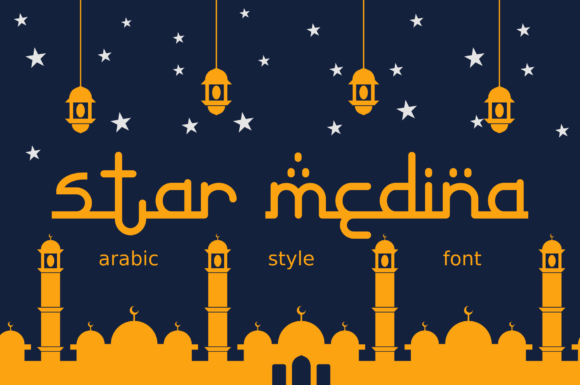
Star Medina: A Serif Font Rooted in Arabic Grace
When typography carries intention—not just style—design gains quiet authority. Star Medina is more than a serif font; it’s a thoughtful bridge between classical Arabic calligraphic rhythm and contemporary typographic clarity. Its structure honors the fluidity of Arabic script—notice how its serifs echo the tapered endings of naskh letterforms, how its vertical stress subtly mirrors the upright elegance of traditional thuluth, and how its generous x-height supports legibility without sacrificing character. For designers, marketers, educators, or small business owners working across bilingual or culturally resonant contexts, Star Medina offers something rare: visual distinction grounded in linguistic respect.
Why Typographic Nuance Matters in Real Projects
Consider a university lecturer designing a syllabus for a course on Islamic art history. They want materials that feel scholarly yet accessible—no sterile sans-serifs, no decorative fonts that distract. Star Medina delivers readability at small sizes while retaining warmth and gravitas. Its balanced proportions mean body text flows smoothly in PDFs, printed handouts, and digital slides—without requiring manual kerning adjustments or line-height overrides. That’s time saved not just in execution, but in decision fatigue: one font that works reliably across formats means fewer compromises during layout.
Stronger Communication Across Languages and Audiences
Star Medina was designed with multilingual harmony in mind—not as an afterthought, but as a core principle. Its Latin glyphs were crafted to complement, not mimic, its Arabic counterparts. The result? A cohesive voice when pairing English headlines with Arabic subheads—or vice versa. A Cairo-based boutique publishing house uses Star Medina for bilingual poetry chapbooks: the font preserves poetic line breaks in Arabic while ensuring English translations retain rhythmic pacing. Similarly, a Toronto-based nonprofit creating community health guides for Arab-Canadian families finds that Star Medina builds immediate familiarity—its forms signal cultural resonance before a single word is read.
Creative Confidence Without Compromise
Freelancers and small studio teams often juggle tight deadlines and diverse client needs. Star Medina simplifies that balance. Its six weights—from delicate Light to commanding Black—offer expressive range without needing supplemental type families. A branding designer building a visual identity for a heritage olive oil brand might use Star Medina Bold for the logo (evoking artisanal strength), then switch seamlessly to Regular for product labels and Italic for tasting notes—all while maintaining tonal consistency. No need to hunt for a “matching” sans-serif for captions or data tables; Star Medina’s clarity holds up even in dense information layouts like ingredient lists or sustainability reports.
Where Star Medina Fits—and Where It Doesn’t
It excels in editorial design, institutional communications, luxury packaging, educational resources, and cultural storytelling. It’s less suited for ultra-narrow UI buttons, fast-paced social media carousels demanding extreme scannability, or environments where strict WCAG AAA contrast is non-negotiable *and* light-weight variants are required (its Light weight meets AA at 16px+, but not AAA without background adjustment). These aren’t flaws—they’re intentional boundaries. Star Medina prioritizes aesthetic integrity and linguistic authenticity over universal technical coverage. If your project demands maximum screen versatility across all devices and accessibility tiers, pairing it with a tested, highly engineered companion font may be wise.
Supporting Creativity Through Structure
For bloggers and content creators, typography shapes reader trust. Star Medina’s subtle stroke modulation—gentler than Didot, warmer than Times New Roman—lends seriousness without austerity. A food writer documenting family recipes from Aleppo uses Star Medina for recipe titles and narrative headers; readers report feeling “invited in,” not lectured to. That’s not magic—it’s the effect of human-scale contrast and open counters that ease eye movement across long paragraphs. Unlike many display serifs, Star Medina doesn’t sacrifice functionality for flair. Its punctuation marks align cleanly with baseline grids, its numerals are true tabular (crucial for pricing tables or timelines), and its OpenType features include contextual alternates for Arabic that respond intelligently to adjacent characters—no manual glyph swapping needed.
Efficiency That Grows With Your Workflow
Time savings compound quietly. Because Star Medina includes full Arabic support (including Persian and Urdu extensions), designers avoid switching tools or outsourcing Arabic typesetting. A Dubai-based marketing agency reduced client revision cycles by 30% on bilingual campaign assets after standardizing on Star Medina—their copywriters no longer flagged inconsistent diacritic positioning, and their developers reported smoother CSS font loading due to optimized file structure. Even hobbyists benefit: someone designing wedding invitations with Arabic and English names finds that Star Medina handles ligature-rich phrases like “Alhamdulillah” or “Insha’Allah” with natural spacing, eliminating hours of manual tweaking.
A Note on Intentional Use
Star Medina isn’t a “drop-in upgrade” for every project—but that’s its strength. Its presence signals care. When a small publisher selects it for a collection of translated Sufi poetry, they’re not just choosing a font; they’re affirming continuity between tradition and modern expression. When an educator uses it in classroom posters about Arabic scientific contributions, students subconsciously register respect—not just decoration. That alignment between form and purpose is what makes Star Medina memorable: it doesn’t shout, but it lingers.
Getting Started Thoughtfully
If you work regularly with Arabic text—or serve audiences for whom Arabic script carries cultural, spiritual, or linguistic significance—Star Medina deserves serious consideration. Try it first in low-stakes but high-visibility contexts: a newsletter header, a presentation title slide, or a portfolio case study description. Observe how it behaves at different sizes, in print versus screen, alongside your existing color palette. Notice whether it sharpens focus or softens tone. Fonts reveal their value through sustained use—not first impressions. And because Star Medina avoids trend-driven extremes, it ages gracefully: a brochure set in it today will feel considered, not dated, five years from now.
Ultimately, Star Medina serves those who understand that typography is never neutral. It’s a tool for honoring context, clarifying meaning, and connecting across difference—with quiet confidence, not loud assertion. Whether you're launching a new brand, teaching a language class, publishing research, or sharing stories that matter, the right serif can do more than look good. It can hold space for what’s being said—and for who’s listening.