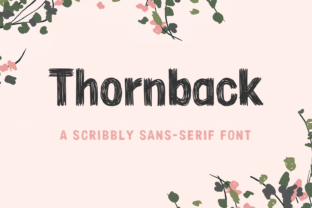
Thornback: A Hand-Drawn Font with Purpose and Personality
Fonts do more than spell out words—they set tone, shape perception, and quietly influence how your message lands. Thornback stands apart not because it’s polished or pixel-perfect, but because it’s intentionally human: a hand-drawn sans-serif built from quick, scribbled strokes that feel alive on the page. It’s not designed to disappear into the background. Instead, Thornback invites attention—warmly, authentically, and without pretense.
What Makes Thornback Distinctive?
At first glance, Thornback looks like something sketched in a notebook during a brainstorming session—slightly uneven, full of character, yet unmistakably legible. Its letters are detailed but never fussy, bold enough for impact but soft enough to avoid intimidation. Unlike many “handwritten” fonts that lean heavily into cursive flourishes or exaggerated quirks, Thornback stays grounded in sans-serif structure. That balance is intentional—and useful.
Each glyph carries subtle variations in stroke weight and angle, mimicking the natural rhythm of pen-on-paper. There’s no uniformity for uniformity’s sake. Instead, you’ll notice slight shifts in baseline alignment, organic curves, and occasional ink-like tapering at stroke ends. These aren’t flaws—they’re features that lend authenticity and warmth.
Where Thornback Shines (and Where It Doesn’t)
Thornback excels in contexts where personality matters as much as clarity. Think of it as the visual equivalent of speaking with expressive gestures and a relaxed smile—not shouting, but holding space with confidence and charm.
- Headlines and hero text: Its strong presence commands attention without sacrificing readability—even at larger sizes. A magazine cover, event poster, or homepage banner gains instant approachability when set in Thornback.
- Branding for small businesses and creative studios: Cafés, indie bookshops, craft collectives, and design agencies often choose Thornback to reflect their hands-on values and community-first ethos.
- Short-form digital content: Social media graphics, email headers, or app onboarding screens benefit from its friendly boldness—especially when paired with a clean supporting font like Inter or Open Sans.
- Printed materials with tactile appeal: Letterpress business cards, zines, workshop handouts, and packaging labels gain texture and intentionality when Thornback is part of the typographic mix.
That said, Thornback isn’t meant for long paragraphs or dense data tables. Its expressive nature works best when given room to breathe. Using it for body copy across an entire website or report would strain legibility and dilute its impact. It’s a spotlight font—not a stage light.
Who Benefits Most From Thornback?
The value of Thornback isn’t universal—but it’s deeply resonant for specific audiences:
- Independent creators who want their typography to echo their process—whether they’re illustrators, ceramicists, podcasters, or educators building a personal brand rooted in authenticity.
- Small business owners launching or rebranding without a big design budget. Thornback delivers distinction fast: no need for custom lettering when the font already feels handmade and intentional.
- Marketing and communications teams looking to soften corporate messaging—say, for an internal campaign encouraging collaboration or a sustainability initiative highlighting grassroots action.
- Nonprofits and community organizations aiming to convey warmth and accessibility, especially when reaching diverse or underserved audiences who may associate overly formal type with distance or bureaucracy.
Practical Considerations Before You Use Thornback
Like any tool, Thornback performs best when matched thoughtfully to the job at hand. Here’s what to keep in mind:
- Pair it wisely. Thornback thrives alongside neutral, highly legible fonts. Try it with a well-spaced sans-serif (like Lato or Source Sans Pro) for contrast and balance—or even a gentle serif (like Merriweather) for editorial depth. Avoid pairing it with other decorative or script fonts; the result can feel cluttered rather than cohesive.
- Respect hierarchy. Use size, weight, and spacing deliberately. Because Thornback has visual weight even at smaller sizes, a 16px headline might read louder than a 24px setting of a standard sans-serif. Test at multiple scales and in real context—not just in design software.
- Check rendering across devices. While Thornback displays beautifully on modern browsers and high-DPI screens, older systems or embedded PDF viewers may simplify fine details. If print fidelity is critical, request a test proof—especially for small point sizes or reversed-out text (e.g., white Thornback on dark backgrounds).
- Licensing matters. Thornback is available under various licenses depending on use—web, desktop, app, or merchandise. Always verify permissions before deploying it in client work or commercial products. Free versions often come with usage restrictions; paid licenses typically include extended support and updates.
Real-World Uses That Work Well
Consider these everyday examples where Thornback adds tangible value:
- A local bakery’s weekly newsletter header, paired with a simple body font—immediately signals care, craft, and neighborhood connection.
- An online course landing page for a workshop on mindful journaling—the font reinforces the theme of reflection and personal expression before a single word is read.
- A nonprofit’s annual impact report cover, using Thornback for the title and subtitle only—making serious content feel grounded and human-centered.
- A teacher’s classroom poster about growth mindset—its informal energy helps students engage without feeling lectured.
Evaluating Whether Thornback Fits Your Project
Ask yourself these three questions before committing:
- Does this project benefit from warmth over formality? If your goal is to build trust, invite participation, or signal openness, Thornback aligns naturally. If precision, authority, or neutrality is paramount (e.g., legal disclaimers, technical documentation), another font may serve better.
- Is there enough visual breathing room? Thornback needs contrast and simplicity around it. Crowded layouts, busy backgrounds, or competing graphic elements will mute its effect—and possibly reduce legibility.
- Will it scale meaningfully across touchpoints? Test it in at least two formats—say, a printed flyer and a mobile web banner. Does it retain its voice? Does it still feel intentional and clear? If yes, you’re likely a good match.
There’s no “right” font for every situation—but there is a right font for the feeling you want people to carry away. With Thornback, that feeling is often one of grounded creativity: thoughtful, unpolished, and quietly confident. It doesn’t try to be everything. It simply does what it does—with honesty and care.
If you’ve ever chosen a handwritten note over an email, or picked up a locally made mug instead of a mass-produced one, you already understand the quiet power Thornback embodies. It’s typography with a heartbeat—and sometimes, that’s exactly what your message needs.