Larissa Beauty: Where Elegant Typography Meets Functional Versatility
Typography is rarely just about letters—it’s about tone, intention, and silent communication. In a digital landscape saturated with interchangeable sans-serifs and overused display fonts, Larissa Beauty stands apart not through novelty alone, but through thoughtful duality: a graceful script paired with a purpose-built uppercase companion. This isn’t a font family designed for fleeting trends; it’s engineered for legibility, emotional resonance, and real-world adaptability across print, web, branding, and experiential design.
Two Complementary Glyph Sets, One Unified Voice
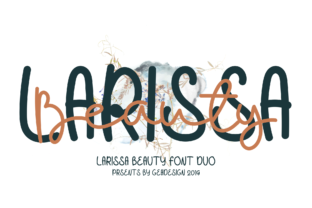
The core strength of Larissa Beauty lies in its intentional pairing: the Larissa Beauty Script and the Larissa Beauty Uppercase versions. They share identical x-heights, stroke weights, terminal shapes, and spacing logic—yet serve fundamentally different roles. The script version flows with organic rhythm, featuring subtle entry and exit strokes, gentle contrast between thick and thin lines, and carefully calibrated letter connections that avoid visual clutter. It’s not overly ornate, nor does it sacrifice readability at moderate sizes—making it viable for headlines, invitations, product labels, and even short-form web banners.
The uppercase variant, meanwhile, is not a simplified “caps lock” rendering of the script. It’s a distinct, standalone design—geometrically grounded yet softened by consistent curvature, open apertures, and balanced negative space. Each capital letter retains the warmth and personality of the script without mimicking its fluidity. This deliberate separation allows designers to maintain tonal consistency while solving practical hierarchy problems: imagine a wedding suite where “Emily & James” appears in the flowing script, while “Saturday, June 15th • Oakwood Gardens” renders cleanly and authoritatively in the uppercase version—same family, no cognitive dissonance.
Why Dual-Font Systems Matter Beyond Aesthetics
In professional design workflows, single-font families often force compromises. A beautiful script may falter in body text or data-heavy contexts; a crisp sans-serif can feel emotionally detached when warmth is required. Larissa Beauty Duo eliminates that trade-off—not by offering dozens of weights or widths, but by delivering two highly specialized, harmonized tools.
Consider a small-batch skincare brand launching a new line of botanical serums. Their packaging needs elegance (script for the product name), clarity (uppercase for ingredient lists and certifications), and shelf impact (both working together on the front label). With Larissa Beauty, the transition from “Lumina Bloom Serum” in script to “Vegan • Cruelty-Free • Made in France” in uppercase feels cohesive—not like switching gears, but deepening emphasis. That cohesion builds trust: consumers subconsciously register consistency as professionalism and care.
Educators designing workshop handouts benefit similarly. A title in Larissa Beauty Script invites engagement; section headers or key takeaways set in the uppercase version provide scannable structure without visual fatigue. For researchers preparing conference posters, the script lends approachability to titles (“Rethinking Urban Green Spaces”), while the uppercase ensures methodology notes, citations, and data labels remain unambiguous under gallery lighting or quick glances.
Real-World Legibility Across Mediums
Legibility isn’t theoretical—it’s tested in context. Unlike many script fonts that blur or collapse at small sizes or on low-resolution screens, Larissa Beauty Script maintains integrity down to 18px on retina displays and 24pt in printed collateral. Its generous counters (the enclosed spaces within letters like ‘e’, ‘a’, and ‘o’) prevent ink fill-in during offset printing. The uppercase version, with its even stroke modulation and generous letter-spacing presets, performs exceptionally well in UI components: buttons, navigation bars, and form labels retain clarity even with limited pixel density or constrained width.
Hobbyists creating handmade greeting cards appreciate how the script’s natural flow translates beautifully to cut vinyl or embossed foil—its terminals are designed to lift cleanly from the substrate. Business owners building Shopify stores find the duo integrates smoothly with theme editors: the uppercase variant anchors product tags and policy links, while the script elevates hero banners and email subject lines without requiring custom CSS overrides.
Strategic Implementation: When to Choose Which Version
Effective typography hinges on intention—not decoration. Here’s how professionals navigate the Larissa Beauty Duo with purpose:
- Lead with emotion, then clarify with precision: Use the script for names, taglines, quotes, or calls to action where human connection matters most. Follow immediately with the uppercase for supporting details—dates, locations, disclaimers, or technical specs.
- Establish hierarchy without contrast overload: Instead of stacking bold sans-serif over light script (a common but jarring combo), use both Larissa Beauty variants. The visual weight difference comes from form, not font weight—creating harmony rather than tension.
- Solve accessibility constraints elegantly: Screen readers parse uppercase text reliably. Pairing the script (visually rich but less machine-readable) with the uppercase (clear, structured, semantic) satisfies both aesthetic and functional requirements—especially in digital publications or educational materials.
- Streamline brand guidelines: Rather than defining separate font stacks for “elegant” and “functional” contexts, a single family reduces documentation complexity. Designers, developers, and marketing teams reference one source—lowering implementation errors and ensuring cross-channel fidelity.
Subtle Technical Nuances That Impact Workflow
Beyond appearance, Larissa Beauty includes OpenType features that enhance usability. Standard ligatures in the script version improve rhythm in common letter pairs (‘fi’, ‘fl’, ‘ff’), while discretionary ligatures offer refined alternatives for high-end applications like luxury packaging or editorial features. The uppercase variant includes case-sensitive forms—optimized capital glyphs that pair correctly with surrounding lowercase text when mixed in running copy (e.g., acronyms within a paragraph).
Kerning pairs are extensively tuned—not just for default combinations, but for edge cases common in branding: “AV”, “To”, “Ye”, and “Wa” all receive individual attention. This means less manual adjustment in Adobe Illustrator or Figma, fewer last-minute kerning tweaks before press checks, and more predictable results across platforms—from Canva templates to WordPress themes.
Who Benefits Most—and How
The versatility of Larissa Beauty Duo makes it relevant far beyond graphic designers. Consider these scenarios:
- Creative entrepreneurs launching Etsy shops or Instagram-based services use the script for shop names and product titles, the uppercase for pricing, shipping notes, and FAQ headers—maintaining brand voice across every customer touchpoint without licensing multiple fonts.
- Nonprofit communicators crafting donor appeals balance warmth and authority: a heartfelt headline in script (“Your Support Grows Hope”) followed by clear impact metrics in uppercase (“$42,000 Raised • 12 Communities Served”).
- Academic publishers applying the duo to book covers achieve distinction: script for the title, uppercase for author name and series imprint—reinforcing scholarly credibility while standing out on crowded shelves.
- Interior designers specifying signage for boutique hotels use the script for room names (“The Azure Suite”) and the uppercase for amenities listed beside doorways (“King Bed • Rainfall Shower • Local Art”).
Thoughtful Constraints, Intentional Outcomes
It’s worth noting what Larissa Beauty does not attempt: it offers no condensed, extra-bold, or monospace variants. That restraint is strategic. By focusing on two highly refined, interoperable forms, the design prioritizes coherence over comprehensiveness. This aligns with modern best practices—where fewer, better-integrated assets yield stronger brand recognition and reduce decision fatigue for creators.
For educators teaching typography fundamentals, this duality serves as a teachable model: how contrast can emerge from structure rather than weight or width; how personality and professionalism coexist; how typographic choices directly shape audience perception and retention. Students analyzing real-world examples—from artisanal coffee bags to university commencement programs—quickly recognize the quiet confidence of the Larissa Beauty Duo in action.
Integration Without Friction
Implementation is straightforward across environments. Web projects leverage standard @font-face declarations or variable font loading via Google Fonts (if hosted there) or self-hosted CDNs. Desktop applications like Affinity Designer, Sketch, and CorelDRAW recognize both files as discrete, fully featured fonts—no special plugins required. For developers embedding in email templates, the uppercase variant reliably renders in Outlook and Apple Mail where script fonts often fail, allowing fallback strategies that preserve hierarchy and tone.
And because both fonts share identical metrics—including ascender/descender heights and baseline alignment—switching between them mid-layout rarely disrupts grid systems or responsive containers. That predictability saves hours in production—time redirected toward content refinement, user testing, or strategic iteration.
In an era where authenticity is valued over artifice, Larissa Beauty delivers something rare: sophistication without pretension, beauty without fragility, and unity without uniformity. It doesn’t shout for attention—it earns it, quietly, consistently, and across every medium where words meet meaning.