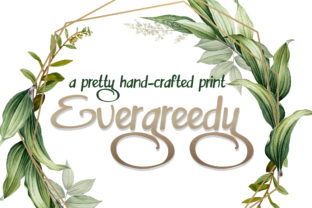
Evergreedy: Where Handwritten Authenticity Meets Everyday Design
Typography isn’t just about legibility—it’s about resonance. In a digital landscape saturated with polished, algorithmically optimized fonts, something unexpected has begun to thrive: the unfiltered warmth of human handwriting. Enter Evergreedy—a font that doesn’t try to disappear into the background. Instead, it leans in, grins, and invites conversation. Designed with deliberate imperfection and expressive energy, Evergreedy is more than a typeface; it’s a design attitude made tangible.
The Anatomy of Authenticity
What makes Evergreedy feel so unmistakably *human*? It starts with its construction. Unlike geometric sans-serifs or meticulously kerned serifs, Evergreedy embraces variation as a core principle. Each letterform carries subtle shifts in stroke weight, slight tilts in baseline alignment, and organic entry/exit flourishes—details that mirror how ink flows from pen to paper. The “a” might sit slightly higher than the “o”; the crossbar of the “t” may wobble ever so gently; the tail of the “y” curls with uneven confidence. These aren’t bugs—they’re features engineered to evoke presence, personality, and approachability.
This authenticity isn’t accidental. It’s rooted in observational typography: studying real handwriting across ages, cultures, and contexts—from chalkboard notes in classrooms to grocery lists scribbled on napkins, from protest signs held aloft to journal entries penned late at night. Evergreedy distills that lived-in quality into a cohesive, usable family—retaining spontaneity while ensuring consistency across sizes and applications.
Who Finds Value in This Kind of Type?
Evergreedy resonates across disciplines—not because it fits every use case, but because it solves specific, often overlooked, communication challenges. Its appeal spans diverse roles:
- Educators use it to soften learning materials—turning dense syllabi into welcoming welcome letters, or transforming worksheet headers into visual cues that say, “This is for you, not just for grading.” One middle school science teacher reported a measurable uptick in student engagement when replacing sterile PDF titles with Evergreedy-displayed unit names like “The Wild World of Weather Systems.”
- Small business owners, especially those in food, craft, wellness, or local retail, rely on Evergreedy to signal care and craftsmanship. A bakery’s chalkboard menu, a ceramicist’s product tag, or a yoga studio’s seasonal schedule—all gain tactile credibility when set in Evergreedy. It quietly communicates, “We made this by hand—and we mean that literally and figuratively.”
- Content creators and marketers deploy it strategically in hero sections, email subject lines, or social banners where tone matters more than neutrality. When a sustainable skincare brand swaps a generic display font for Evergreedy in its Instagram story headline (“Your Skin Deserves Better”), the shift isn’t just aesthetic—it’s tonal anchoring.
- Researchers and nonprofit communicators find utility in Evergreedy for humanizing data storytelling. Pairing clean, structured body text (like a readable serif or neutral sans) with Evergreedy subheads—e.g., “What We Heard From 327 Caregivers”—creates an immediate emotional bridge between statistics and lived experience.
Practical Integration: Where and How It Works Best
Like any expressive tool, Evergreedy thrives within intentional boundaries. It excels in short-form, high-impact contexts—but falters when asked to carry long paragraphs or dense interfaces. Here’s how professionals apply it with precision:
Headlines and Brand Signifiers
Used at 36px and above, Evergreedy commands attention without shouting. Its generous x-height and open counters ensure clarity even on mobile screens. Designers often pair it with a highly legible companion font (such as Inter, Lora, or Source Sans Pro) for body copy—creating a dynamic yet balanced hierarchy. A university’s alumni newsletter, for instance, might use Evergreedy for section titles (“Stories From the Field”) and switch seamlessly to a crisp sans-serif for interview transcripts.
Interactive Elements with Personality
Buttons, call-to-action banners, and form labels benefit from Evergreedy’s friendliness—especially in contexts where trust and approachability are paramount. A mental health app’s “Start Your Journey” CTA gains quiet empathy when rendered in Evergreedy, contrasting thoughtfully with the calm neutrality of its interface text. Crucially, developers confirm Evergreedy renders reliably across modern browsers and supports standard web font loading strategies (WOFF2, variable fallbacks), making implementation straightforward.
Print and Physical Touchpoints
In physical spaces—think posters, packaging, signage, or event programs—Evergreedy’s texture translates beautifully. Its irregularities become assets under natural light or when printed on textured paper. A community garden’s seasonal workshop flyer gains warmth when the date and title (“Seed Starting 101 — Sunday, April 7”) appear in Evergreedy, while practical details remain in a clean secondary typeface.
What to Consider Before Choosing Evergreedy
Authenticity comes with responsibilities. Because Evergreedy prioritizes character over uniformity, certain scenarios demand thoughtful evaluation:
- Accessibility: While fully functional for most users, its stylistic variations can pose minor challenges for some readers with dyslexia or low vision. Best practice is to reserve Evergreedy for non-critical, decorative, or large-display uses—and always maintain sufficient contrast (minimum 4.5:1 against background). Never use it for legal disclaimers, error messages, or navigation labels requiring rapid parsing.
- Brand Alignment: Evergreedy signals informality, creativity, and warmth. It sits uneasily beside corporate identities built on austerity, precision engineering, or institutional gravitas—imagine a central bank’s annual report or a surgical device manual. That mismatch isn’t a flaw in the font; it’s a mismatch in intention.
- Language Support: The standard Evergreedy release covers Latin-based languages comprehensively (including extended diacritics for French, Spanish, German, and Scandinavian tongues). However, it does not include Cyrillic, Greek, or East Asian character sets. Teams working with multilingual audiences should verify coverage early in the design process.
Observations from Real-World Use
Design teams consistently note two recurring patterns when adopting Evergreedy:
- It accelerates emotional calibration. In collaborative workshops, presenting a mockup with Evergreedy in the headline often sparks faster consensus around tone than abstract discussions about “friendliness” or “approachability.” The font makes intangible qualities visible—and debatable—in concrete form.
- It encourages restraint. Because Evergreedy carries such strong voice, users naturally limit its application—reserving it for moments that truly warrant emphasis. This self-regulation often leads to cleaner, more intentional layouts overall. As one UX writer observed: “Once we started using Evergreedy, we stopped over-designing headlines. We realized fewer words, better placed, said more.”
Beyond Aesthetics: The Cultural Shift It Reflects
Evergreedy arrives amid a broader recalibration in digital culture—one increasingly skeptical of frictionless perfection. Users scroll past hyper-polished ads and pause at content that feels witnessed, imperfect, and human-scaled. This isn’t nostalgia; it’s responsiveness. Tools like Evergreedy give designers a responsible way to embed humanity into interfaces without resorting to stock imagery or forced whimsy.
Consider how educators now share lesson plans via open repositories: many annotate PDFs with handwritten margin notes in Evergreedy—transforming static documents into living artifacts. Or how researchers publishing fieldwork findings overlay Evergreedy captions on documentary photos, reinforcing that these aren’t abstractions but grounded observations. In each case, the font serves as a quiet signature of authorship and care.
Implementation Notes for Developers and Designers
Integrating Evergreedy is lightweight. It’s available through major font services (Google Fonts, Adobe Fonts) and as self-hosted files. For performance-conscious sites, consider loading it only on pages where it’s visually essential—using @font-face declarations with font-display: swap to avoid invisible text during load. Design systems benefit from defining clear usage guidelines: e.g., “Evergreedy is permitted only for H1–H3 headings at ≥28px, primary CTAs, and branded illustrations—never for body, caption, or data table text.”
Color treatment matters too. Evergreedy sings in deep charcoal, forest green, or warm terracotta—but can feel muddy in low-saturation greys or overly bright neons. Test print and screen rendering side-by-side, especially if supporting both physical and digital distribution.
A Font That Grows With Its Users
What distinguishes Evergreedy from trend-driven display fonts is its staying power—not as a stylistic artifact, but as a functional ally. It doesn’t chase novelty; it deepens connection. Whether you’re sketching a wireframe, drafting a grant application, designing a festival poster, or annotating student feedback, Evergreedy offers a consistent, recognizable voice—one that says, “I’m here, I’m real, and I’m paying attention.”
Its boldness isn’t loudness. Its fun isn’t frivolity. Its authenticity isn’t performative—it’s earned through thoughtful construction and responsive application. In a world where attention is scarce and trust is fragile, choosing a font like Evergreedy is rarely just a design decision. It’s a quiet declaration of values: that clarity need not sacrifice warmth, that professionalism need not erase personality, and that the most effective communication often begins—not with perfection—but with presence.