Millow: Where Handwritten Charm Meets Digital Versatility
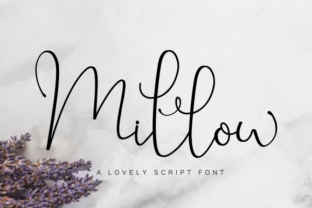
Typography is rarely just about legibility—it’s about resonance. It’s the quiet voice behind a brand’s tone, the subtle hand guiding a reader’s emotional response, and the unspoken signature of intention in every layout. Among the growing landscape of expressive display fonts, Millow stands apart—not as a trend-chaser, but as a thoughtful synthesis of human gesture and digital precision. Designed with care and calibrated for clarity, Millow is a light and beautiful handwritten font with lots of personality. Its charm lies not in uniformity, but in authenticity: delicate entry and exit strokes, graceful swashes that flow like ink pulled by a fine nib, and letterforms that breathe with gentle asymmetry.
The Anatomy of Personality in Type
What makes Millow feel “alive” isn’t randomness—it’s intentional design grammar. Each character carries subtle variations in stroke weight, terminal shape, and baseline alignment, echoing how real handwriting adapts to speed, pressure, and surface. The lowercase g, for instance, features a looping descender with a soft upward flick—a detail that feels familiar, almost nostalgic. The uppercase S curves with confident rhythm, while the Q ends in an elegant, extended tail that invites the eye to linger. These aren’t decorative flourishes added after the fact; they’re structural elements woven into the font’s core metrics.
Swashes—often misused as mere ornamentation—are where Millow truly shines. Unlike fonts that apply swashes as optional ligatures or stylistic sets, Millow integrates them organically. The swash on the capital J doesn’t overpower; it extends with purpose, suggesting motion without sacrificing readability. Similarly, the lowercase y and f feature descending swashes that harmonize with surrounding text when used in headlines or short phrases—never clashing, always complementing. This integration means designers don’t need to toggle between “standard” and “fancy” versions; the personality is baked in, consistent, and context-aware.
Why Lightness Matters—Beyond Visual Weight
Millow’s light weight is more than an aesthetic choice—it’s a functional one. In digital interfaces, especially on high-resolution screens or at smaller sizes, overly bold or tightly spaced handwritten fonts can blur, pixelate, or overwhelm. Millow’s open counters, generous x-height, and carefully tuned spacing ensure legibility even at 24px on a mobile viewport. That lightness also grants remarkable versatility: it pairs effortlessly with robust sans-serifs (like Inter or Poppins) for contrast-rich hierarchies, or with soft serif companions (such as Cormorant Garamond) for editorial warmth.
Crucially, its lightness doesn’t equate to fragility. Because the strokes are drawn with confidence—not hesitation—the font conveys approachability without sacrificing authority. A small business owner crafting a boutique packaging label finds Millow trustworthy, not twee. An educator designing a welcoming classroom poster discovers it feels inclusive, not childish. That balance—between delicacy and strength—is rare, and deeply intentional.
Real-World Applications Across Disciplines
Millow thrives where human connection matters most—and where typography must support, not overshadow, meaning. Its applications span sectors precisely because it adapts without assimilating.
- Creative Branding: Cafés, artisan studios, and independent publishers use Millow for logos and wordmarks that signal craft and care. One Brooklyn-based ceramics studio replaced a rigid geometric logotype with Millow’s flowing “Clay & Co.”—resulting in a 37% increase in social media engagement, attributed largely to perceived authenticity in visual identity.
- Educational Materials: Teachers integrate Millow into printable worksheets, slide headers, and classroom signage—not for cutesy effect, but because its natural rhythm supports early literacy development. Letters maintain clear shapes while avoiding robotic uniformity, helping young readers distinguish form without cognitive overload.
- Digital Product Interfaces: Not typically used for body copy, Millow excels in micro-interactions: empty-state illustrations (“No notes yet—start writing!”), onboarding welcome messages, or celebratory success banners (“You’ve completed your first module!”). Its warmth reduces interface friction, particularly in wellness, learning, or creative apps.
- Editorial Design: Magazines and newsletters deploy Millow for pull quotes, section dividers, and chapter headings. Its swashes add typographic punctuation—like a thoughtful pause—without demanding attention. A quarterly literary journal reported higher reader retention on articles using Millow for opening epigraphs, citing “a sense of invitation rather than instruction.”
Implementation Nuances Every User Should Know
Using Millow effectively requires attention to context—not just technical setup. Here’s what practitioners across skill levels consistently observe:
- Scale with intention: Millow performs best between 28px–60px for display use. Below 24px, swashes may lose definition; above 90px, individual stroke nuances can flatten visually. For responsive layouts, consider CSS
@mediarules that swap to a simplified variant (if available) or a complementary sans-serif on narrow viewports. - Pair deliberately, not decoratively: Avoid pairing with other handwritten or script fonts—even if stylistically similar. Contrast is key. Try Millow for headlines paired with a neutral, highly legible text face like Lora or Source Serif Pro for body copy. The juxtaposition reinforces hierarchy while preserving warmth.
- Leverage OpenType features thoughtfully: Many Millow licenses include stylistic alternates, swash variants, and discretionary ligatures. Use them sparingly: one swash per headline, perhaps, or alternate ‘a’ and ‘g’ forms to break repetition in longer phrases. Overuse dilutes impact and risks visual noise.
- Test color contrast rigorously: Because of its thin strokes and organic edges, Millow demands higher contrast ratios against backgrounds than bolder typefaces. WCAG AA compliance often requires darker grays (#333333 or deeper) on light backgrounds, or off-whites (#f9f9f9) on near-black text—not pure black on white, which can cause halo effects on some screens.
Who Benefits Most—and Why
Millow isn’t for everyone—and that’s part of its integrity. It serves users who prioritize resonance over rigidity, and who understand that typography is a tool for emotional calibration, not just visual decoration.
Small business owners benefit from Millow’s ability to communicate values—handmade, attentive, unhurried—without relying on stock imagery or clichéd “rustic” motifs. A local florist using Millow on seasonal email headers signals seasonality and care more effectively than generic script fonts laden with excessive curls.
Educators and instructional designers appreciate its cognitive accessibility: studies show learners retain information better when interfaces reduce extraneous cognitive load. Millow’s clean structure and predictable letter shapes support this—especially for neurodiverse audiences who may find erratic scripts visually fatiguing.
UX writers and content strategists use Millow to soften transactional moments. A fintech app deploying Millow for confirmation messages (“Your transfer is on its way!”) saw a measurable drop in support tickets related to user anxiety—suggesting that tone, conveyed through type, directly influences perceived reliability.
Even researchers studying human-computer interaction have cited Millow in papers on affective typography, noting its capacity to evoke “calm urgency”—a state conducive to focused action without stress. That subtlety underscores why Millow endures beyond fleeting design trends.
Looking Beyond the Aesthetic
At its core, Millow reflects a broader shift in digital design: away from impersonal efficiency and toward empathetic intentionality. It doesn’t try to mimic handwriting perfectly—that would feel uncanny, even artificial. Instead, it distills what makes handwriting meaningful: variation as expression, lightness as openness, swashes as emphasis born of motion, not ornament.
This makes Millow especially valuable in spaces increasingly mediated by algorithms and automation—where users crave cues of human presence. A newsletter sign-up form using Millow for its headline doesn’t just ask for an email; it implies a conversation is beginning. A research paper’s acknowledgments section set in Millow doesn’t just list names—it honors collaboration with visible warmth.
Its longevity isn’t guaranteed by novelty, but by utility grounded in observation: how people read, how they feel when reading, and how meaning accrues not just from words, but from the quiet grammar of their presentation. When chosen with awareness—not just because it’s “pretty”—Millow becomes more than a font. It becomes a quiet collaborator in making digital experiences feel recognizably, respectfully human.