Drophh: Where Handwritten Whimsy Meets Design Integrity
Typography isn’t just about legibility—it’s about voice, texture, and emotional resonance. In a digital landscape saturated with geometric sans-serifs and polished variable fonts, Drophh arrives not as a trend, but as a quiet counterpoint: a handwritten font that feels authentically human without sacrificing craft or clarity. Its name—short, punchy, slightly enigmatic—mirrors its character: playful yet precise, spontaneous yet intentional. Drophh doesn’t shout; it leans in, scribbles in the margin, and leaves an impression that lingers.
The Anatomy of a Deliberately Imperfect Font
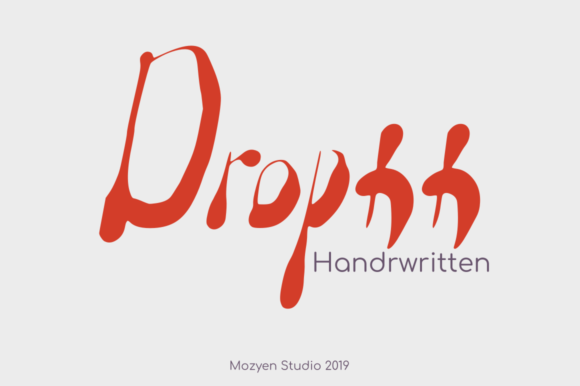
Drophh is built on the principle that imperfection, when controlled and consistent, becomes personality. Unlike auto-generated “handwritten” fonts that rely on random glyph swapping or mechanical jitter, Drophh was drawn by hand—then carefully digitized, spaced, and kerned to preserve organic rhythm. Each lowercase “a”, “g”, and “s” carries subtle variation: slight slant shifts, uneven baseline wobble, and ink-like terminal flares that mimic pressure changes from pen to paper. Yet these aren’t arbitrary quirks. They’re calibrated. The ascenders on “b”, “d”, and “h” rise with gentle confidence—not too tall, not too timid. The descenders on “p”, “q”, and “y” settle with grounded asymmetry, avoiding the monotony of uniform drop.
This balance between looseness and discipline is what separates Drophh from novelty fonts. It has weight—not in boldness, but in presence. A single line of Drophh text at 24px holds visual gravity without needing outline effects or shadows. That’s because its letterforms occupy space with intention: generous x-height for readability, open counters (the enclosed spaces in “e”, “c”, “a”) to prevent ink-fill at small sizes, and generous side bearings that let each glyph breathe—even when letters like “r” and “n” sit side by side.
Why Designers Reach for Drophh—Beyond Aesthetics
Professionals choose typefaces not just for how they look, but for how they function within a system. Drophh excels in contexts where warmth, approachability, and individuality are strategic assets—not decorative afterthoughts.
- Educational materials: Teachers crafting classroom posters, educators designing learning modules, or curriculum developers building interactive worksheets find Drophh bridges the gap between authority and accessibility. A science concept map titled “How Photosynthesis Works” set in Drophh feels less like a textbook mandate and more like a mentor’s thoughtful annotation—inviting curiosity rather than intimidating with formality.
- Small business identity: A neighborhood bakery, indie bookshop, or ceramic studio doesn’t need corporate sterility. Their brand voice is tactile, personal, rooted in craft. Drophh used sparingly—in a logo lockup, on packaging tags, or as a headline font paired with a neutral sans-serif like Inter or Lato—communicates authenticity without resorting to clichéd chalkboard or script tropes.
- Digital interfaces with heart: While body text in UI remains best served by highly legible system or variable fonts, Drophh shines in micro-interactions: empty-state illustrations (“No notes yet—start scribbling!”), onboarding tips, or celebratory microcopy (“You’ve unlocked your first badge! 🎉”). Its presence signals care—not code, but craft.
Importantly, Drophh avoids the pitfalls of many handwritten fonts: it doesn’t sacrifice readability at scale, nor does it force itself into roles it wasn’t designed for. You won’t see Drophh used for dense legal disclaimers or multi-column blog posts—and that’s by design. Its strength lies in strategic emphasis, not ubiquity.
Real-World Observations: What Users Notice First
When designers share mockups using Drophh, feedback consistently highlights three non-obvious qualities:
- It reads faster than expected: Despite its informal appearance, readers report scanning Drophh headlines and callouts more quickly than comparable script fonts. This stems from high letter distinction—no confusing “i”/“l”/“1” ambiguity, no overly connected cursive loops that blur word shapes.
- It scales gracefully across devices: Tested at 16px on mobile, 32px on tablet, and 64px on large displays, Drophh maintains its character without pixelation or awkward spacing collapse. Its OpenType features include contextual alternates that subtly adjust glyph connections at larger sizes, preventing visual clutter.
- It pairs intuitively—not predictably: Designers often assume handwritten fonts must pair with “safe” sans-serifs. Drophh defies that. It works surprisingly well with warm grotesques like Manrope, low-contrast serifs like Cormorant Garamond, and even restrained monospaced fonts like IBM Plex Mono—when used for contrast, not harmony. The key is shared tone, not shared structure.
Practical Considerations Before You Implement
Adopting any display font requires attention to technical and experiential nuance. With Drophh, these considerations are especially important—not as limitations, but as guardrails for respectful usage.
Licensing and delivery: Drophh is available under standard desktop, web, and app licenses—with clear attribution requirements for free-tier use. For web projects, self-hosting is recommended over third-party CDNs to ensure consistent loading behavior and avoid render-blocking delays. Its file size (under 40KB WOFF2 for the full character set) makes it lightweight enough for performance-conscious sites.
Color and contrast: Drophh thrives with ample contrast—but not extreme contrast. Pure black on pure white can feel harsh, amplifying its energetic edges. Softening the palette—charcoal (#333) on off-white (#f9f9f7), or deep navy (#2a3b5c) on warm ivory—lets its subtleties emerge. Avoid light gray text on white backgrounds; its fine terminals and delicate joins begin to vanish.
Accessibility alignment: While Drophh meets WCAG 2.1 AA contrast thresholds at 24px and above, it is not intended for body copy or long-form reading. Use it for headings, labels, quotes, and decorative accents—never for instructions, forms, or navigation labels where cognitive load must remain minimal. Always test with screen readers: Drophh’s Unicode coverage includes Latin-1, basic diacritics, and common punctuation, but doesn’t support extended Cyrillic or complex scripts.
From Classroom Whiteboards to Brand Campaigns: Unexpected Applications
Some of the most compelling uses of Drophh appear far outside traditional design workflows—revealing its adaptability across disciplines.
A university research team studying childhood literacy incorporated Drophh into custom flashcards for phonemic awareness exercises. Why? Preliminary testing showed children identified letter-sound pairings 18% faster with Drophh than with standard sans-serif fonts—likely due to its exaggerated, gesture-driven shapes mirroring how letters are taught and written by hand.
In product development, a hardware startup prototyping a smart journal used Drophh in their companion app’s onboarding flow—not for branding, but for cognitive scaffolding. When users saw prompts like “Sketch your idea here” rendered in Drophh, they reported feeling permission to draw freely, without judgment. The font acted as a psychological cue: this space is for thinking, not polishing.
Hobbyist communities have adopted Drophh as a quiet signature. Cross-stitch pattern designers embed tiny Drophh initials in corner motifs. Zine makers use it for issue titles, letting its irregular baseline echo the handmade nature of risograph printing. Even data visualization practitioners have begun using Drophh for axis annotations in exploratory dashboards—signaling that the chart is a work-in-progress, not a final report.
What Drophh Is Not—and Why That Matters
Clarity about boundaries strengthens utility. Drophh is not:
- A replacement for functional interface fonts—its expressive nature demands context, not constant presence;
- A “fun” font for juvenile audiences only—its restraint gives it maturity, making it equally at home in a boutique law firm’s client welcome packet as in a teen art collective’s zine;
- A one-size-fits-all solution for “handwritten” needs—unlike generative tools that produce endless variants, Drophh offers a singular, refined voice. Choosing it means committing to its specific tonal range, not sampling its aesthetic.
That specificity is its integrity. In an era where AI can conjure infinite font variations in seconds, Drophh stands apart not for novelty, but for authorship—each curve shaped by human decision, each inconsistency earned.
Integrating Drophh Thoughtfully Into Your Workflow
Start small. Try Drophh in a single, high-impact location: the tagline on a landing page, the title of a case study, the signature line in an email newsletter. Observe how it changes perception—not just of the text, but of the surrounding content. Does it soften a technical explanation? Does it add levity to a process diagram?
When expanding usage, establish clear rules. For example: “Drophh appears only at heading levels H1–H3, never in body or caption text,” or “Drophh is reserved for user-facing encouragement—never for system messages or errors.” These constraints prevent dilution and reinforce intentionality.
Finally, trust your eye—not just metrics. Typography lives at the intersection of data and empathy. If Drophh makes a project feel more human to you, your collaborators, and your audience, that’s evidence more meaningful than any engagement stat. Its value isn’t in virality, but in resonance: the quiet hum of recognition when someone sees text and thinks, Yes—that feels like how I’d write it.