Lonely High: The Handwritten Font That Bridges Nostalgia and Modern Design
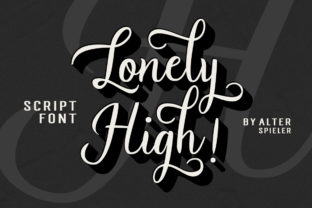
Typography is rarely neutral—it carries tone, intention, and cultural resonance. Among the thousands of digital typefaces available today, Lonely High stands apart not because it shouts for attention, but because it invites quiet recognition. It’s a beautiful and elegant handwritten font, with a unique feel—fluid yet deliberate, nostalgic yet contemporary. Its curves echo ink-on-paper authenticity; its spacing breathes like handwritten correspondence from a slower, more considered era. But unlike many retro-inspired fonts that lean heavily into kitsch or affectation, Lonely High balances expressive charm with functional clarity—making it as viable for a university lecture slide as it is for a boutique wedding invitation.
What Makes Lonely High Distinctive—Beyond “Handwritten”
Calling a font “handwritten” is only the starting point. Many fonts mimic handwriting superficially—through uneven baselines, variable stroke widths, or simulated pen lifts—but Lonely High goes deeper. Its letterforms were crafted with intentional rhythm: ascenders rise with gentle confidence, descenders taper with subtle asymmetry, and connecting strokes between letters (especially in cursive-style settings) preserve the organic hesitation of real pen movement—not mechanical repetition. There are no forced ligatures or algorithmic flourishes. Instead, variations appear naturally across alternate glyphs: a lowercase “a” might offer two distinct forms, a “g” may shift between single- and double-storey options, and capital “S” or “Q” carry slight angularity that hints at vintage sign painting rather than calligraphy school.
This isn’t simulation—it’s translation. The designer didn’t digitize a single script sample and replicate it endlessly. They studied decades of mid-century stationery, typewritten marginalia, and hand-lettered bookplates, then distilled those visual memories into a cohesive, usable system. The result? A font family that feels lived-in—not sterile, not over-polished, but consistently human.
Where Lonely High Finds Purpose in Real Workflows
Because of its tonal precision and restrained elegance, Lonely High excels where voice matters more than volume. Consider these practical applications:
- Educational materials: Instructors designing reading guides or discussion prompts often struggle to avoid clinical detachment. Using Lonely High for pull quotes, reflection prompts, or section headers adds warmth without sacrificing legibility—even at 18–24pt sizes on projected slides or printed handouts.
- Research communication: Academic posters, conference banners, and grant proposal cover pages benefit from typography that signals thoughtfulness. Lonely High conveys care in presentation without implying informality—particularly effective when paired with a clean sans-serif body font like Inter or Lato for contrast.
- Brand storytelling: Small businesses centered on craft, sustainability, or personal service—think ceramic studios, independent bookshops, or holistic wellness practices—use Lonely High in logos, packaging copy, or website hero text to suggest authenticity rooted in individual attention, not mass production.
- Creative documentation: Journaling apps, digital scrapbooking tools, and note-taking platforms increasingly support custom fonts. Users selecting Lonely High aren’t just choosing aesthetics—they’re curating an interface that supports reflective, unhurried thinking.
Importantly, Lonely High avoids common pitfalls of expressive fonts: it scales well across devices, renders crisply on both Retina and standard displays, and includes full Latin-1 support plus thoughtful punctuation spacing. It’s not limited to decorative accents—it holds up in longer passages when used judiciously (e.g., short paragraphs, bullet summaries, or captioned visuals).
Designers’ Observations: When to Lean In—and When to Step Back
Experienced typographers note that Lonely High performs best when treated as a *voice*, not a *vibe*. That distinction matters. Applying it broadly across an entire website or document dilutes its impact and risks visual fatigue. Instead, designers report strongest results when using it intentionally:
- As a primary display face: For headlines, chapter titles, or signature statements—where its elegance anchors meaning.
- In layered hierarchy: Paired with a neutral, highly legible sans-serif (e.g., Manrope or IBM Plex Sans) for body text, creating contrast that guides attention without competing.
- In constrained color palettes: Works especially well in muted tones—charcoal gray on off-white, deep navy on cream, or even soft terracotta on pale linen—reinforcing its tactile, analog associations.
- With ample whitespace: Its expressive nature needs room to breathe. Tight line-heights or cramped margins mute its grace.
One educator shared how she uses Lonely High exclusively for student feedback comments in digital gradebooks: “It transforms assessment from transactional to relational. Students tell me my notes feel ‘seen,’ not scanned.” That anecdote reflects a broader truth—Lonely High subtly shifts perception by signaling presence, not just production.
Why “Retro-Inspired” Doesn’t Mean “Out of Time”
Retro design trends often fall into two traps: ironic detachment (“look how quaint”) or uncritical replication (“let’s just use 1950s everything”). Lonely High avoids both. Its retro qualities—slight irregularity, warm contrast, modest x-height—are grounded in functional history: mid-century educators used similar scripts to make learning materials feel approachable; small publishers chose them to signal craftsmanship over commercialism; letter writers relied on such forms to convey sincerity without formality.
What makes Lonely High relevant now is how it answers contemporary needs: in an age saturated with algorithmically generated content and AI-polished interfaces, people respond to traces of human variation. Not perfection—but evidence of choice, pause, and care. That’s why researchers studying digital literacy observe increased engagement with documents featuring intentional typographic warmth. It doesn’t distract; it disarms.
Further, its technical execution respects modern standards. Unlike some vintage revivals that lack OpenType features or Unicode breadth, Lonely High includes stylistic sets, contextual alternates, and localized diacritics—supporting multilingual academic publishing, inclusive branding, and global educational contexts without fallback compromises.
Practical Considerations Before Implementation
Adopting any expressive font requires thoughtful integration. With Lonely High, three considerations stand out:
- Licensing clarity: Verify usage rights for your context—web embedding, desktop design, app integration, and print distribution each have distinct requirements. Some versions include variable weight axes (though Lonely High itself is currently offered in a single, carefully tuned weight), so confirm compatibility with your tools.
- Accessibility awareness: While highly legible at appropriate sizes, avoid using it for long-form body text or low-contrast combinations. Always test readability with screen readers and color-contrast checkers—its beauty shouldn’t compromise inclusion.
- Performance mindfulness: As a well-hinted, optimized font file, it loads efficiently—but if deploying via web font services, consider subsetting for critical characters only when appropriate, especially for high-traffic sites.
These aren’t limitations—they’re invitations to engage deliberately. Choosing Lonely High isn’t about applying a filter; it’s about aligning typography with purpose.
From Letterform to Language: A Quiet Shift in Communication
Ultimately, Lonely High resonates because it participates in a quiet cultural recalibration—one where “professional” no longer means “impersonal,” and “elegant” needn’t mean “distant.” It’s found in the handwritten thank-you note from a nonprofit director, the chalkboard menu at a community café, the title treatment on a documentary about intergenerational knowledge transfer. Each use affirms that clarity and warmth aren’t opposites—they’re collaborators.
For creators balancing aesthetic integrity with audience connection, Lonely High offers more than visual appeal. It provides a vocabulary for nuance: a way to say “this matters” without shouting, “I made this with attention” without boasting, “you’re welcome here” without stating it outright. That’s the power of thoughtful typography—not decoration, but dialogue.
Fall in love with this retro-inspired font—not for its nostalgia alone, but for what it enables today: quieter confidence, warmer authority, and design that remembers the hand behind the message.