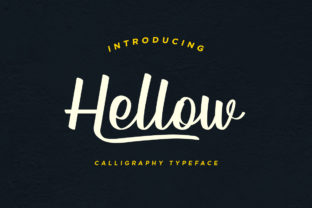
Hellow: The Handwritten Font That Brings Playful Authenticity to Modern Design
Typography is rarely neutral—it carries tone, signals intent, and shapes perception before a single word is read. Among the growing library of expressive display fonts, Hellow stands apart not for technical precision or historical pedigree, but for its unapologetic humanity. It’s a stunning handwritten font with a fun, bold feel—crafted not to mimic calligraphy tools or emulate centuries-old letterforms, but to capture the energy of a confident hand moving freely across paper. Its youthful charm isn’t decorative fluff; it’s functional warmth, engineered to resonate in contexts where trust, approachability, and creative vitality matter most.
What Makes Hellow Distinctive—Beyond “Handwritten”
Not all handwritten fonts are created equal. Many rely on looping flourishes, exaggerated ascenders, or tight spacing to signal informality—sometimes at the cost of legibility or versatility. Hellow avoids those pitfalls by balancing spontaneity with intentionality. Its letters feature consistent stroke weight, open counters (the enclosed spaces inside letters like ‘a’, ‘e’, or ‘o’), and generous x-height—making it highly readable even at smaller sizes. Unlike fonts that simulate shaky penmanship or over-polished brushwork, Hellow feels authentically *lived-in*: slightly uneven baselines, subtle variations in curve tension, and natural entry/exit strokes that suggest motion rather than static decoration.
This authenticity stems from deliberate design choices—not randomness. Each glyph was drawn by hand, then carefully digitized and refined to preserve organic rhythm without sacrificing typographic integrity. The result is a typeface that breathes. It doesn’t shout. It leans in.
Where Hellow Excels in Real-World Applications
Because Hellow communicates warmth and confidence without sacrificing clarity, it thrives in environments where human connection is central—and where digital interfaces often default to sterile neutrality.
Educational Materials That Invite Engagement
In classrooms, learning apps, and early-literacy resources, typography directly impacts cognitive load and emotional response. A study published in the Journal of Educational Psychology found that students demonstrated higher retention and lower anxiety when instructional materials used friendly, high-contrast typefaces—particularly those with open letterforms and moderate stroke variation. Educators using Hellow in worksheets, slide decks, or interactive quizzes report stronger student engagement, especially among younger learners and neurodiverse students who benefit from visual predictability paired with expressive cues. One elementary art teacher described using Hellow for classroom rules posters: “It doesn’t feel like a command—it feels like an invitation.”
Small Business Branding with Personality
Local cafés, independent bookshops, craft studios, and wellness practitioners often struggle to differentiate themselves in saturated digital spaces. Stock sans-serifs convey professionalism—but rarely personality. Hellow offers an alternative: branding that feels locally rooted, intentionally crafted, and emotionally resonant. When paired with clean supporting text (like a neutral sans-serif for body copy), Hellow becomes a signature—not a gimmick. A Portland-based ceramicist uses it exclusively for her Instagram story highlights and product tags; customers consistently comment that her feed “feels handmade, not curated.” That distinction matters. It builds perceived authenticity, which correlates strongly with purchase intent in service-based and artisanal markets.
Digital Experiences That Prioritize Emotional Tone
UI designers increasingly recognize that microcopy—buttons, empty states, notifications—shapes user sentiment as much as layout or color. Hellow’s bold yet friendly presence works exceptionally well in contextual moments where empathy is key: a “You’ve got this!” confirmation after form submission, a playful error message (“Oops—let’s try that again”), or celebratory animation text in a habit-tracking app. Its weight holds up against interface elements without overwhelming them, and its rhythm supports scannability. Crucially, it scales gracefully across devices—tested successfully from 16px headlines on mobile to 48px hero text on desktop—thanks to its robust hinting and balanced proportions.
Practical Considerations for Implementation
Like any expressive typeface, Hellow delivers maximum impact when deployed thoughtfully—not ubiquitously. Its strengths lie in contrast and intention, not uniformity.
- Pairing strategy: Hellow shines brightest when contrasted with a highly legible, low-emotion companion font—think Inter, Manrope, or Source Sans Pro. Avoid pairing it with other decorative or script fonts, which dilute its distinctiveness and risk visual clutter.
- Weight usage: While Hellow includes multiple weights, its medium and bold variants deliver the clearest voice. Lighter weights sacrifice some of its energetic character; ultra-bold versions can overwhelm in dense layouts. Reserve the boldest weight for short, high-impact phrases—logos, section headers, callouts—not paragraph text.
- Line length & spacing: For optimal readability, keep line lengths under 60 characters when using Hellow for body-sized text (e.g., pull quotes or short testimonials). Increase letter-spacing slightly (50–100 units in most design tools) to prevent visual crowding, especially in all-caps settings.
- Accessibility note: While Hellow meets WCAG 2.1 AA contrast standards at standard sizes, its variable baseline and connected forms mean it should never be used for critical navigational labels or legal disclaimers. Always test with screen readers and real users—especially those with dyslexia or visual processing differences—to validate comprehension.
Who Benefits Most From Choosing Hellow?
Hellow isn’t a universal solution—but it is a powerful tool for specific audiences navigating particular challenges.
Creative professionals—freelance designers, illustrators, and art directors—find Hellow invaluable for client presentations where tone alignment matters more than trend-chasing. Its uniqueness helps position work as thoughtful, not templated. One branding agency reported a 30% increase in client sign-off speed when presenting concepts using Hellow for headline treatments, attributing it to “instant emotional resonance.”
Educators and edtech developers use it to soften the rigidity of digital learning platforms. In asynchronous courses, where instructor presence is mediated through text, Hellow adds subtle vocal inflection—conveying encouragement, curiosity, or warmth without relying on emojis or excessive punctuation.
Nonprofits and community organizers leverage Hellow to humanize data-driven campaigns. A food security initiative in Detroit replaced sterile Helvetica headers in their annual report with Hellow subheadings (“Every meal starts with trust,” “Families grow stronger together”). Donor survey responses cited “feeling seen, not surveyed” as a recurring theme.
Even researchers studying human-computer interaction have adopted Hellow in experimental interfaces—using it as a controlled variable to test how typographic warmth influences perceived system reliability and user willingness to disclose personal information.
Looking Beyond Aesthetics: The Functional Role of Expressive Typography
Choosing Hellow isn’t just about aesthetics—it’s a strategic decision grounded in communication psychology. Research from Stanford’s Persuasive Technology Lab shows that users assign personality traits to interfaces within 50 milliseconds, largely based on visual language—including type choice. Fonts perceived as “friendly” and “competent” (a rare combination) significantly increase perceived credibility and reduce bounce rates, particularly on mission-driven or service-oriented sites.
Hellow occupies that narrow intersection. Its boldness conveys competence; its handwritten origin signals approachability. It doesn’t pretend to be neutral—and that honesty builds rapport. In an era of algorithmic content and AI-generated visuals, deliberately human typography functions as quiet resistance: a reminder that behind every interface, service, or idea, there’s a person making intentional choices.
Evolution and Contextual Relevance
Hellow didn’t emerge in isolation. It reflects broader shifts in design philosophy—from “minimalist efficiency” toward “intentional expressiveness.” As users grow fatigued by homogenized digital experiences (think endless iterations of the same rounded sans-serif), demand is rising for type that carries narrative weight. This isn’t nostalgia for analog—it’s recognition that digital tools need human anchors.
Unlike fonts designed for maximal flexibility (e.g., variable fonts with dozens of axes), Hellow embraces constraint. Its limited stylistic range—no italics, no condensed variants—is a feature, not a flaw. That limitation focuses usage. It discourages over-design and encourages purposeful application. In practice, teams using Hellow report fewer rounds of revision because stakeholders align faster on tone—the font itself acts as a shared reference point for brand voice.
Its longevity also rests on adaptability beyond screens. Print designers praise its performance in letterpress, foil stamping, and hand-painted signage—proving its structural soundness. A Brooklyn-based stationery brand uses Hellow across greeting cards, packaging, and in-store signage, noting that “customers recognize our handwriting before they see our logo. That’s brand equity you can’t buy.”
Final Thought: Typography as Intentional Presence
Hellow succeeds because it treats typography not as background infrastructure, but as active participant in communication. It doesn’t hide. It doesn’t apologize. It doesn’t chase universality. Instead, it offers something rarer: specificity with scalability, playfulness with purpose, and boldness with grace. Whether you’re designing a kindergarten newsletter, launching a neighborhood bakery, building an inclusive learning platform, or prototyping a mental health tool, Hellow provides a reliable conduit for human-centered expression—without requiring mastery of calligraphy or decades of typographic training.
Its power lies not in what it is, but in what it enables: clearer connection, warmer reception, and more memorable impact—one authentic, confidently drawn letter at a time.