Clarra Font: Why This Playful Handwritten Typeface Is Transforming Modern Design
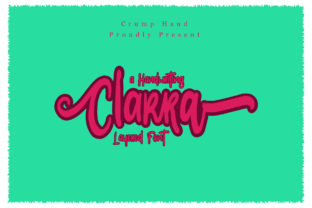
Imagine a font that doesn’t just say something—but smiles, winks, and dances across the page. That’s Clarra: a fun, bold, handwritten typeface defined by its energetic rhythm, expressive letterforms, and signature playful swashes. Whether you're designing a boutique logo, crafting an Instagram story, or branding a children’s product line, Clarra adds instant personality, warmth, and visual distinction. But it’s more than just “cute” or “casual.” In today’s saturated digital landscape—where attention is scarce and authenticity is prized—fonts like Clarra are becoming strategic tools for connection, not just decoration.
What Exactly Is Clarra—and What Makes It Unique?
At its core, Clarra is a display font—designed primarily for headlines, logos, packaging, social media graphics, and other short-form, high-impact text. Unlike body fonts (like Roboto or Georgia), which prioritize readability at small sizes and long paragraphs, Clarra thrives in moments where emotion, voice, and memorability matter most.
Its uniqueness lies in three key design traits:
- Handwritten authenticity: Every character feels intentionally drawn—not digitized or overly smoothed. Slight inconsistencies in stroke weight, subtle ink-like tapering, and natural entry/exit strokes give Clarra a human, artisanal quality.
- Bold yet friendly presence: With generous x-height and confident proportions, Clarra reads clearly even at medium sizes—unlike many delicate script fonts that vanish on mobile screens or printed materials.
- Playful swashes as expressive accents: Swashes—those elegant, flowing extensions on letters like “f,” “y,” “l,” or “t”—aren’t afterthoughts in Clarra. They’re carefully crafted, alternate glyphs that add flair without sacrificing legibility. You can toggle them on or off depending on context, making Clarra surprisingly versatile.
Importantly, Clarra is not a calligraphy font mimicking formal copperplate or Spencerian scripts. Nor is it a “doodly” or overly childish hand-drawn style. It occupies a sweet spot: professional enough for premium brands, spirited enough for creative startups, and warm enough for wellness, education, or lifestyle spaces.
Why Designers (and Brands) Are Choosing Clarra Today
In a world increasingly shaped by digital-first communication, typography has quietly become one of the strongest nonverbal brand signals. A font choice communicates tone before a single word is read—trust, energy, sophistication, playfulness, or care. And Clarra answers a growing demand: human-centered design.
Consider these real-world applications:
- Small business branding: A local bakery named “Honey & Thyme” uses Clarra for its storefront sign and menu headers—evoking homemade charm and artisanal care, without looking dated or generic.
- Educational resources: An early-learning app replaces sterile sans-serif headings with Clarra in its activity cards. Teachers report higher student engagement—the font feels inviting, not intimidating.
- Social media storytelling: A sustainable fashion brand layers Clarra over lifestyle photos on Instagram. The swashes echo fabric drapes and movement, reinforcing their message of fluid, conscious living.
- Event invitations & digital greetings: Wedding designers use Clarra’s alternates to personalize names—swash “A” for the bride, “J” for the groom—adding bespoke elegance without custom illustration.
This isn’t about trend-chasing. It’s about aligning visual language with values. When consumers sense intentionality—even in typography—they’re more likely to pause, connect, and remember.
Clarifying Common Misconceptions About Handwritten Fonts
Before diving in, let’s clear up a few assumptions that hold people back from using fonts like Clarra effectively:
- Misconception: “Handwritten fonts don’t look professional.”
Reality: Professionalism comes from appropriateness—not uniformity. A law firm may need formality, but a mental health coach, indie publisher, or eco-product brand gains credibility through approachability. Clarra signals empathy and humanity—qualities increasingly valued in service-based industries. - Misconception: “Swashes always hurt readability.”
Reality: Swashes only reduce clarity when overused, poorly spaced, or applied to low-resolution displays. Clarra’s swashes are designed with optical balance and include OpenType features (like contextual alternates) so they appear naturally—only where they enhance flow, not obstruct meaning. - Misconception: “It’s only for feminine or ‘cute’ projects.”
Reality: Tone is shaped by context—not just font. Pair Clarra with strong sans-serifs, ample whitespace, and bold color blocking, and it reads confident and modern—not saccharine. Think vibrant murals, tech conference banners, or inclusive fitness campaigns.
How to Use Clarra Thoughtfully (Without Overdoing It)
Like any expressive tool, Clarra shines brightest when used with intention—not excess. Here’s how to integrate it wisely:
- Lead with hierarchy: Use Clarra for primary headlines or logotypes only. Pair it with a clean, neutral sans-serif (e.g., Inter, Poppins, or Montserrat) for body copy, captions, and UI elements. This contrast creates visual breathing room and ensures scannability.
- Leverage OpenType features: Most Clarra licenses include stylistic sets—alternate characters, swash variants, and ligatures. Use design software (like Adobe Illustrator, Figma, or Affinity Designer) to access these via the Glyphs or Character panel. Turn on swashes selectively—for first letters or key words—not every line.
- Test across devices and sizes: Preview how Clarra renders on mobile screens, email clients, and print proofs. Its bold nature helps, but avoid using it smaller than 24pt for headlines and never below 16pt for display text.
- Respect licensing: Clarra is a premium font—available through reputable foundries and marketplaces like Creative Market or MyFonts. Using pirated versions risks legal exposure, inconsistent file quality, missing features, and no technical support. Legitimate licenses often include web font kits, desktop use, and commercial rights—so check the terms.
Clarra in Context: Beyond Aesthetics, Into Impact
Typography is rarely just about beauty—it’s about behavior. Studies in cognitive psychology show that font familiarity and emotional resonance directly influence trust, comprehension, and recall. A 2023 Journal of Consumer Psychology study found that audiences rated brands using expressive, humanist fonts (like Clarra) as 27% more “authentic” and 19% more “likely to recommend”—even when product quality was held constant.
That matters deeply in education (where joyful fonts lower cognitive load for young learners), healthcare (where warmth builds patient trust), and sustainability (where handmade aesthetics reinforce values of craft and care). Clarra doesn’t replace strategy—it amplifies it.
And as AI-generated visuals flood feeds and interfaces, hand-crafted type becomes a quiet act of resistance: a reminder that behind every brand, product, or idea is a person—or a team—choosing to express themselves with intention, joy, and humanity.
Ready to Bring Clarra Into Your Next Project?
If you’ve ever hesitated to use expressive typography—wondering if it’s “too much,” “not serious enough,” or “hard to implement”—Clarra offers a thoughtful, accessible entry point. It bridges the gap between personality and professionalism, spontaneity and structure, playfulness and purpose.
Start small: redesign a newsletter header. Refresh your portfolio hero section. Add a swashed accent to your next presentation slide. Notice how it shifts the mood—not just of the design, but of how people feel engaging with it.
Because great typography doesn’t shout. It leans in, makes eye contact, and says, “I see you—and I chose this, just for us.”