Oneirically: Where Handwritten Charm Meets Everyday Clarity
Typography isn’t just about legibility—it’s about resonance. It’s the quiet handshake between a brand and its audience, the subtle tone-setter in an educational slide, the warm nudge that invites a child to linger over a storybook page. In this landscape, Oneirically stands apart not by technical complexity, but by its unpretentious sincerity. It’s a handwritten font with an adorable charm—playful without being childish, relaxed without sacrificing readability, and consistently human in a digital world increasingly shaped by algorithms and automation.
The Quiet Strength of Simplicity
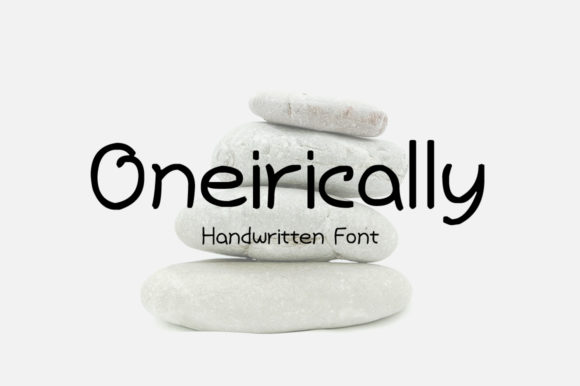
Oneirically doesn’t shout. Its lowercase “a” has a soft, open bowl; its “g” curves gently like a sleeping cat; its “t” features a slight upward tilt at the crossbar—not rigid, not slanted, but quietly confident. These aren’t arbitrary quirks. They’re deliberate echoes of natural handwriting: the slight variation in stroke weight, the organic rhythm of pen lift and reposition, the gentle inconsistency that signals authenticity. Unlike many script fonts that rely on dramatic flourishes or exaggerated connections, Oneirically opts for restraint. Letters breathe. Spaces feel intentional. The result? A typeface that feels approachable at 12pt on a mobile screen—and equally expressive at 60pt on a classroom poster.
This simplicity is its greatest functional strength. Designers often assume handwritten fonts belong only to greeting cards or boutique packaging. But Oneirically proves otherwise. Its even x-height, generous counters (the enclosed spaces inside letters like “e” or “o”), and consistent baseline alignment mean it performs well across contexts where clarity matters: lesson plans for early learners, accessibility-forward signage in community centers, internal workshop handouts for nonprofit teams, or even annotated diagrams in research collaboration tools. It bridges the gap between personality and practicality—something few handwritten fonts achieve without compromise.
Real-World Applications Across Diverse Roles
What makes Oneirically uniquely useful isn’t just how it looks—but how it *works* in the hands of people solving real problems.
Educators Crafting Welcoming Learning Environments
In elementary classrooms, typography shapes emotional safety. A worksheet set in a cold, monospaced sans-serif can unintentionally signal “this is formal, this is serious, this is easy to get wrong.” Oneirically shifts that subtext. When a first-grade teacher uses it for vocabulary flashcards or daily schedule boards, students subconsciously register warmth and invitation. One literacy coach in Portland reported that using Oneirically for phonics practice sheets reduced student hesitation during independent reading time—students described the words as “friendly” and “like my teacher wrote them herself.” That’s not anecdote; it’s evidence of typographic empathy in action.
Creatives Building Brand Personality Without Overdesigning
Small business owners—especially those in wellness, handmade goods, or local services—often struggle to convey authenticity without falling into cliché. A yoga studio’s website might default to overly ornate scripts or sterile minimalism. Oneirically offers a third path: grounded, kind, unhurried. A ceramicist in Asheville uses it exclusively for her product tags and email newsletters—not as decoration, but as voice. Customers tell her the font “feels like the glaze on her mugs: smooth, handmade, quietly intentional.” Here, Oneirically isn’t masking lack of design skill; it’s amplifying intentionality.
Researchers and Educators Communicating Complex Ideas Gently
Academic communication doesn’t have to be austere. When presenting qualitative findings—say, interview excerpts from community health outreach—a rigid academic font can unintentionally distance readers from lived experience. Oneirically, used sparingly for pull quotes or participant reflections, reintroduces humanity. A public health researcher at the University of New Mexico integrated it into a community report on food access. Local stakeholders commented that the font “made the data feel like it belonged to us, not just about us.” That nuance—making information feel shared rather than delivered—is where Oneirically earns its place in serious work.
Technical Considerations That Support Real Workflows
Adorable charm means little if the font fails in production. Fortunately, Oneirically was built with pragmatic use in mind—not just aesthetic appeal.
- Robust character set: Includes full Latin-1 support, common diacritics (á, ñ, ü), and essential punctuation—no scrambling for alternate glyphs mid-project.
- Optimized hinting: Renders crisply on Windows and older Android devices, avoiding the blurry edges that plague many decorative fonts at small sizes.
- Light file footprint: Weighs under 45KB as a WOFF2—critical for educators embedding fonts in shared Google Slides templates or nonprofits loading fast on low-bandwidth connections.
- Cross-platform consistency: Behaves predictably in Figma, Adobe Creative Cloud, and web CSS—no surprises when handing off from designer to developer or teacher to admin staff.
These aren’t “nice-to-haves.” They’re what allow a school district’s communications team to deploy Oneirically across 170+ campus websites without IT intervention—or let a freelance illustrator embed it reliably in client PDFs without font substitution warnings.
When—and When Not—to Choose Oneirically
Like any tool, Oneirically excels within certain boundaries. Understanding those boundaries isn’t limitation—it’s precision.
It shines brightest when the goal is human connection over hierarchical authority. Use it for welcome emails, workshop agendas, children’s book illustrations, patient education handouts, or internal team appreciation notes. Its rhythm encourages slower reading, deeper absorption—ideal for reflective or relational content.
It’s less suited for high-density data tables, legal disclaimers requiring absolute neutrality, or interfaces demanding rapid scanning (like airport departure boards). Those contexts call for different virtues: neutrality, speed, universality. Oneirically doesn’t try to be everything—and that focus is part of its integrity.
A telling observation: Teams that adopt Oneirically long-term rarely use it for *everything*. Instead, they treat it like a trusted collaborator—reserved for moments where tone carries equal weight to information. A university department uses it only in their student mentorship program materials, distinguishing that space as intentionally nurturing. A software startup deploys it solely in their onboarding tutorial animations—transforming technical instructions into guided conversations.
Beyond Aesthetics: The Cultural Resonance of Handwritten Type
There’s a quiet cultural shift happening—oneirically mirrors it. After years of hyper-polished, algorithmically optimized digital experiences, users are gravitating toward signals of human presence. Think of the rise of analog photography filters, the popularity of “imperfect” ceramic mugs, or the preference for voice notes over typed messages. Handwriting—even digitally rendered—carries irreplaceable semiotic weight: care, time, individuality, imperfection-as-truth.
Oneirically taps into that without nostalgia or artifice. It doesn’t mimic aged paper or ink bleed. It simply feels like something written recently, with attention, by someone who cares about how the message lands. That’s why it resonates across generations: teens use it for mood-board headers because it feels “unfiltered”; retirees choose it for family newsletter PDFs because it evokes handwritten letters from decades past—yet neither group feels it’s “for” their age group alone.
Integrating Oneirically Thoughtfully
Getting started requires no special tools. It’s available through standard font platforms and supports modern web font loading techniques. But thoughtful integration goes beyond installation.
Start small. Replace one recurring element—like your team’s weekly meeting agenda header—with Oneirically. Notice how it changes the room’s energy in a shared doc. Try pairing it with a highly legible, neutral sans-serif (like Inter or Source Sans) for body text: the contrast creates visual hierarchy while preserving warmth where it matters most.
For developers: leverage CSS @font-face with fallbacks, but also consider when to load it. Does your landing page hero section truly benefit from its charm? Yes. Does your privacy policy’s fine print? Probably not. Prioritize based on emotional intent—not just aesthetics.
And for educators and creators: remember that typography teaches before a single word is read. Choosing Oneirically signals, implicitly, that kindness, approachability, and human-centeredness are part of your methodology—not add-ons, but foundations.
A Font That Grows With Its Users
Oneirically’s longevity lies in its refusal to chase trends. It doesn’t simulate brush strokes or mimic calligraphy tools. It simulates something quieter: the act of writing with presence. That makes it adaptable—not because it’s generic, but because its core value (human warmth) remains relevant whether you’re designing a kindergarten curriculum in 2024 or prototyping an AI-assisted learning interface in 2030.
Its charm isn’t superficial. It’s structural. Every curve, every spacing decision, every subtle irregularity serves the same purpose: to remind the reader—and the creator—that behind every interface, every lesson, every report, there’s a person trying to connect. And sometimes, the most powerful technology isn’t the newest algorithm—it’s a carefully drawn “a” that says, softly, “I’m here with you.”