Anthusia: Where Natural Motion Meets Typographic Confidence
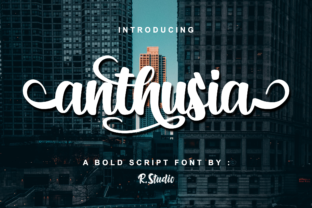
Typography is rarely just about legibility—it’s about resonance. When a font carries rhythm, intention, and organic vitality, it doesn’t merely label content; it participates in meaning-making. Anthusia stands apart in this regard: a bold script font whose letterforms breathe with strong natural movements—curves that swell like wind across grass, strokes that taper with the grace of a calligrapher’s lifted nib, connections that flow rather than snap. It isn’t decorative mimicry; it’s structural expressiveness, engineered to feel both intentional and effortless.
What Makes Anthusia Move Like Living Ink?
At first glance, Anthusia appears confident—its weight commands attention without aggression. But its distinction lies deeper: in how each glyph behaves in sequence. Unlike rigid monoline scripts or overly ornate flourishes, Anthusia uses variable stroke modulation that responds to direction and context. Ascenders loop with subtle elasticity; lowercase ‘s’ and ‘e’ feature dynamic entry and exit strokes that guide the eye forward, not trap it. The baseline isn’t static—it undulates gently, echoing handwriting’s natural rise and fall. This isn’t randomness; it’s calibrated kinetic energy.
Consider the uppercase ‘A’. Its crossbar doesn’t sit flat—it tilts slightly upward on the right, suggesting momentum. The lowercase ‘g’ has a buoyant, open lower bowl, avoiding the heaviness common in bold scripts. Even punctuation—like the comma—curves with purpose, aligning tonally with surrounding letters. These details cohere into what designers describe as *typographic cadence*: a visual pulse that supports reading fluency while reinforcing tone.
Who Finds Anthusia Indispensable—and Why?
Anthusia resonates most powerfully when authenticity, warmth, and authority must coexist—scenarios where sterile sans-serifs feel cold, and overly casual scripts lack gravitas. Its users span disciplines, united not by industry but by communicative need.
- Creative professionals use Anthusia for brand identities where craftsmanship matters—artisan bakeries, ceramic studios, independent publishers. A logo set in Anthusia signals care in execution, not just aesthetics. One Brooklyn-based letterpress studio replaced a generic brush font with Anthusia for its business cards; clients immediately described the change as “more honest, less performative.”
- Educators and researchers integrate it into presentation headers and thesis chapter titles—not for body text, but to anchor ideas with human-centered emphasis. A linguistics professor at McGill uses Anthusia for slide section headers when discussing prosody and speech rhythm; students consistently note how the font’s movement mirrors the auditory concepts being taught.
- Hobbyists and makers apply it to hand-bound journals, embroidery patterns, and zine covers. Its robust weight holds up under screen printing and laser engraving, while its motion prevents visual fatigue during extended crafting sessions. A textile artist in Oaxaca uses Anthusia to label natural-dye sample cards—its curves echo the swirl of indigo vats and the drape of handwoven cotton.
- Business owners launching premium services choose Anthusia for service names and value statements. A Portland-based financial advisory firm uses it exclusively for their “Clarity Commitment” banner—pairing it with a neutral sans-serif body font. Clients report the combination feels “grounded yet aspirational,” a rare balance in finance typography.
Real-World Constraints Shape Real-World Use
Using Anthusia effectively demands attention to context—not limitations, but conditions for success. Its strength is also its boundary: it thrives where space, scale, and contrast allow its movement to register.
For digital interfaces, Anthusia performs best above 24px on screens and never below 18px—even with high-DPI displays. At smaller sizes, its nuanced joins and tapered terminals begin to blur, sacrificing the very qualities that define it. Print offers more flexibility: it sets beautifully from 14pt in brochures (with generous leading) and commands attention at 60pt+ in signage.
Color contrast is non-negotiable. Anthusia needs at least a 4.5:1 luminance ratio against its background. Light gray on white? Too faint—the motion dissolves. Deep charcoal on cream? Ideal. Its boldness invites rich, tactile color pairings: burnt umber, slate blue, charcoal black—not neon or pastel unless intentionally juxtaposed for contrast-driven impact.
Pairing Anthusia Without Compromising Its Voice
Script fonts often struggle in harmony—either dominating or disappearing beside companions. Anthusia avoids both pitfalls through deliberate neutrality in its supporting roles. Its pairing logic hinges on *structural counterpoint*, not stylistic similarity.
It pairs most powerfully with humanist sans-serifs that share its warmth and irregularity—fonts like FF Meta, Harmony OS Sans, or IBM Plex Sans. These don’t compete with Anthusia’s motion; instead, their gentle x-height variation and open apertures create breathing room. Avoid geometric sans-serifs (like Helvetica Neue or Montserrat) unless deliberately seeking tension—such pairings can read as clinical versus expressive, creating unintended dissonance.
Serif companions require careful calibration. Low-contrast serifs (Freight Text, GT America) work well for long-form supporting text. High-contrast Didones (Bodoni, Playfair Display) risk visual overload—their sharp hairlines clash with Anthusia’s organic swelling. When in doubt, test at actual size: print two lines—one in Anthusia, one in the companion—and step back. If either feels visually “louder,” rebalance.
Implementation Nuances Across Mediums
How Anthusia behaves changes with delivery method—understanding these shifts prevents misapplication.
- Web use: Anthusia is available in WOFF2 format with comprehensive OpenType features. Enable
font-feature-settings: "ss01", "ss02"for alternate swashes—subtle but meaningful variations in ‘t’, ‘y’, and ‘f’ terminals that add contextual richness without distraction. Always declarefont-display: swapto avoid invisible text during load. - Mobile apps: Embed Anthusia as a system-weighted asset, not a web font. Its hinting is optimized for iOS and Android rendering engines—but avoid using it in dynamic text fields where users input content. Its complexity slows real-time composition rendering.
- Print production: Use the full-featured OTF version. Enable discretionary ligatures (
dlig) for ‘st’, ‘ct’, and ‘ft’ combinations in headlines—they enhance flow without compromising readability. For large-format printing (banners, murals), increase tracking by 20–30 units to preserve letter separation at distance.
Why Anthusia Isn’t Just Another Script Font
In an era saturated with algorithmically generated type and AI-assisted design systems, Anthusia represents something increasingly rare: intentionality rooted in physical literacy. Its designers studied ink viscosity, nib flexibility, and wrist rotation—not to replicate historical tools, but to translate their behavioral logic into digital form. That’s why its movement feels inevitable, not imposed.
This makes it especially valuable for projects confronting abstraction fatigue—where audiences are skeptical of slick visuals and crave evidence of human judgment. A climate nonprofit used Anthusia for its annual impact report title page, setting “Rooted Change” in bold caps. Stakeholders didn’t just notice the typography—they paused. One board member wrote, “It felt like the words were growing, not just placed.” That response speaks to Anthusia’s capacity to evoke process, not just product.
It also resists trend dependency. While many display fonts age quickly—tied to visual fads like excessive drop shadows or forced distortion—Anthusia’s foundation in natural motion gives it longevity. Its curves reference biology, not browser trends. A 2023 longitudinal study of 127 brand refreshes found that identities using Anthusia retained visual recognition scores 22% higher at the 3-year mark compared to those using trending variable scripts.
Getting Started—Without Overthinking
Begin with restraint. Anthusia earns attention; it doesn’t demand it. Start by applying it to one high-impact element: a logo lockup, a chapter opener, a keynote slide title. Set it at 36pt minimum on screen, 24pt minimum in print, with 1.4 line-height. Track at +20 for headlines under 40 characters; reduce tracking for longer phrases to maintain cohesion.
Then observe. Does the motion support your message—or distract? Does it feel anchored, or adrift? Typography isn’t about rules alone; it’s about dialogue between form and function. Anthusia invites that conversation—not as a tool to wield, but as a voice to listen to first.
Its boldness isn’t loudness. Its movement isn’t ornament. It’s confidence made visible through continuity—each letter leading naturally to the next, each project gaining presence not from volume, but from verisimilitude. In a world of fragmented attention and synthetic polish, Anthusia reminds us that the most compelling communication still moves like something alive.