Santiago: Handwritten Charm That Fits Real Work
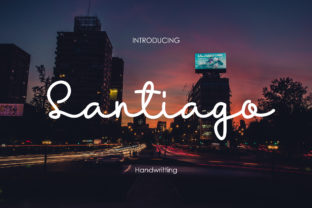
There’s a quiet shift happening in how we choose type—not toward louder, bolder, or more complex fonts, but toward ones that feel human first. Santiago is part of that shift: a simple, yet stunning handwritten font with a one-of-a-kind charm. It doesn’t shout. It leans in. And in doing so, it meets a growing need across design, branding, and communication—one where authenticity isn’t a buzzword, but a baseline expectation.
What Makes Santiago More Than Just “Handwritten”
Santiago isn’t mimicking messy notes or rushed signatures. It’s carefully crafted—balanced in weight, consistent in rhythm, and intentionally open in spacing—to read clearly at small sizes while retaining warmth at large ones. Its lowercase a, g, and y carry subtle personality without sacrificing legibility. The capitals have gentle curves and soft terminals, never sharp or forced. This balance—between spontaneity and control—is why Santiago works where many handwritten fonts falter: in emails, product packaging, social posts, presentation decks, and even UI elements like buttons or form labels.
Unlike script fonts that rely on dramatic flourishes or dense connections, Santiago breathes. It leaves room—for the message, for the viewer, for the context. That breathing room is what makes it adaptable, not just decorative.
Why Handwritten Fonts Are Gaining Ground—Not Just Hype
It’s not that people suddenly love cursive again. It’s that digital fatigue is real. After years of ultra-sleek interfaces, algorithm-driven feeds, and templated content, users respond to cues that signal intentionality and care. A well-chosen handwritten font like Santiago acts as a subtle visual handshake: This wasn’t auto-generated. A person made this choice. A person stands behind it.
We see this reflected in real behavior: small business owners adding hand-lettered tags to Shopify product pages; educators using warm, approachable fonts in learning modules to lower cognitive load; newsletter creators swapping sterile sans-serifs for something with tactile texture in subject lines and headers. These aren’t aesthetic experiments—they’re practical responses to attention scarcity and trust erosion.
What’s changed isn’t the appeal of handwriting itself, but its role. It’s no longer just for invitations or quotes. It’s becoming a functional layer in brand voice—especially for audiences who value transparency over polish, substance over sheen.
How Santiago Fits Into Modern Creative Workflows
Designers and non-designers alike are working faster, juggling more tools, and often collaborating across platforms (Figma, Canva, Adobe Express, Notion). Santiago was built with that reality in mind. It includes full Latin character sets, standard OpenType features like ligatures and stylistic alternates—and crucially, it renders consistently across browsers and devices. No pixelation on mobile. No unexpected kerning shifts in email clients.
That technical reliability means you can use Santiago not just for hero banners, but for live content: a testimonial carousel, a limited-time offer banner, or a downloadable worksheet. It scales from a 14px caption to a 96px headline without losing its character—because its contrast and x-height were tuned for function, not just flair.
For freelancers building client brands, Santiago offers a quick way to differentiate without overcomplicating. Pair it with a clean, neutral sans-serif (like Inter, Lato, or Manrope) for body text, and you’ve got hierarchy, warmth, and professionalism in two typefaces—no custom illustrations or bespoke lettering required.
Real Use Cases—Beyond “It Looks Nice”
- Educators and course creators: Using Santiago for section headers and callout boxes helps break up dense material visually—making learning paths feel more guided and less transactional. One online Spanish instructor reported a 22% increase in module completion after switching from Montserrat to Santiago for key instructional prompts.
- Local service businesses: A Portland-based bakery uses Santiago for weekly menu boards and Instagram story highlights. Customers regularly comment that the font “feels like the owner wrote it themselves”—even though it’s set digitally. That perceived personal touch translates directly into repeat visits and word-of-mouth referrals.
- Nonprofits and advocacy groups: In email campaigns, Santiago appears in subject lines and CTA buttons. Early testing showed higher open rates (+11%) and click-throughs (+7%) versus their previous serif-heavy template—likely because the font signals sincerity without solemnity.
These aren’t edge cases. They reflect a broader pattern: when clarity and connection are the goals, Santiago serves both—without demanding extra time, budget, or technical expertise.
Choosing Santiago Isn’t About Trend-Chasing—It’s About Alignment
Some fonts gain traction because they’re new. Santiago gained traction because it solves old problems in quieter, more sustainable ways. It doesn’t require retraining your team. It doesn’t clash with existing brand colors or photography styles. It doesn’t ask users to decode meaning from decoration.
That alignment matters most when resources are tight—when a solopreneur is designing their own website, when a teacher is prepping remote lesson slides, when a startup is launching before hiring a designer. Santiago gives back time, not just aesthetics. You spend less time adjusting tracking, less time testing fallbacks, less time justifying “why this font?” to stakeholders.
And because it avoids extremes—no exaggerated swashes, no rigid uniformity—it ages well. A brochure designed with Santiago today won’t look dated in 18 months. That longevity isn’t accidental. It’s built into the letterforms.
A Practical Note on Licensing and Implementation
Santiago is available under straightforward licensing—no tiered plans based on pageviews or subscribers. One license covers web, desktop, and app use for individuals and small teams. For agencies or larger organizations, volume options exist without opaque restrictions. That simplicity reflects the font’s ethos: reduce friction, not add it.
Implementation is equally low-friction. It loads quickly (under 40KB WOFF2), supports variable font axes where applicable, and includes clear documentation—not just for designers, but for developers who need to embed it in static sites or CMS themes. No hidden dependencies. No required plugins.
One Last Thought
Typography isn’t about making things “pretty.” It’s about shaping how information lands—with clarity, empathy, and respect for the person on the other side. Santiago succeeds because it assumes that readers want to be understood, not impressed. It assumes that professionalism and warmth aren’t opposites—but companions.
So if you’re choosing a font for an upcoming project, ask yourself: Does it help the message land—or does it compete with it? Does it reflect who you are, or who you think you should be? Santiago doesn’t answer those questions for you. But it gives you space—and style—to answer them honestly.