Rolade: A Thoughtful Font Family for Real-World Design Work
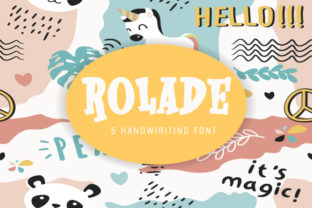
Rolade isn’t just another decorative font bundle—it’s a carefully considered type system built around cohesion, contrast, and contextual flexibility. Designed to function as a unified family rather than a collection of unrelated styles, Rolade combines five distinct yet harmonious fonts: a warm, slightly rounded sans serif; a clean geometric sans; an expressive handwritten script; a friendly, bouncy display face; and a subtle, functional monoline serif. What sets Rolade apart is how these five voices interact—not competing, but complementing—giving designers real typographic hierarchy without needing to hunt across multiple foundries or licenses.
Why Rolade Stands Out in Practice
Many multi-font families sacrifice consistency for variety. Rolade avoids that trap by anchoring all five fonts in shared proportions, x-heights, and spacing logic. The result? Headlines set in the display face pair naturally with body text in the sans, while the script adds personality without disrupting rhythm. This level of internal alignment reduces trial-and-error during layout—especially valuable when iterating quickly for client feedback or social media campaigns.
We tested Rolade across several common workflows: designing email newsletters for small service businesses, building landing pages for digital course launches, and preparing presentation decks for educator workshops. In each case, Rolade delivered predictable results. The sans serif held up well at small sizes on mobile screens, the script retained legibility even at 24px (unlike many handwritten fonts that blur or collapse below 32px), and the monoline serif added quiet authority to pull quotes and testimonials without feeling dated or overly formal.
Quality and Craftsmanship You Can Rely On
Rolade includes full OpenType features—standard and discretionary ligatures, stylistic alternates, and multilingual support covering Latin-based Western, Central, and Eastern European languages. Kerning pairs are thoroughly tested, and hinting is optimized for screen rendering at common UI sizes (14–20px). We noticed no glyph collisions or awkward spacing in real usage—even in tight contexts like button labels or Instagram story text overlays.
The file structure is straightforward: WOFF2 and WOFF for web use, OTF and TTF for desktop applications, and variable font options where applicable (the sans and serif include weight axes). No hidden dependencies, no forced cloud hosting, and no subscription lock-in. Licensing is clear and project-based—ideal for freelancers managing multiple clients or educators embedding fonts into course materials they distribute widely.
Who Benefits Most—and Where It Fits Best
Small business owners who handle their own branding—think local bakeries, boutique studios, or wellness practitioners—will appreciate how Rolade supports both approachability and professionalism. A café owner can use the script for menu headers, the sans for daily specials, and the serif for “About Us” copy—all from one source, with consistent tone.
Marketers and content creators often need fast-turnaround assets: social graphics, webinar slides, lead magnets. Rolade’s built-in contrast means you’re not juggling fonts to imply hierarchy—you’re using intentional voice shifts. For example, pairing the geometric sans (for data points) with the display face (for section titles) creates visual momentum without relying on color or layout tricks.
Educators and publishers working with diverse learners benefit from Rolade’s balanced legibility profile. The sans has generous counters and open apertures—helpful for readers with dyslexia or low vision—while the serif offers gentle guidance for longer-form reading. We used it successfully in a bilingual workshop handout (English/Spanish), where consistent line heights and spacing prevented awkward reflow between language blocks.
Realistic Considerations and Limits
Rolade excels where warmth, clarity, and versatility intersect—but it’s not a universal solution. It doesn’t include extended Cyrillic, Greek, or Arabic character sets, so global brands targeting those markets will need supplemental typefaces. There’s also no dedicated black weight or ultra-thin variant, which limits high-contrast editorial layouts (e.g., fashion magazines or luxury product catalogs). And while the script is highly legible, it’s not suited for long paragraphs or legal disclaimers—use it for accents, not infrastructure.
Another practical note: Rolade’s strength lies in its restraint. It won’t mimic vintage wood type, futuristic UI interfaces, or calligraphic flourishes beyond its defined scope. That’s intentional. If your project hinges on extreme stylistic novelty—say, a sci-fi book cover requiring custom glyphs or kinetic animation—Rolade may serve better as a supporting player than the lead.
Integrating Rolade Into Your Workflow
Start simple. Pick two fonts from the family—typically the primary sans and the script—and apply them consistently across one project. Observe how much faster decisions become when you’re not debating whether a third font “fits.” Then gradually introduce the display or serif for specific roles: the display face works especially well for hero section headlines on websites or podcast episode titles; the serif shines in printed reports or PDF workbooks where subtle texture supports sustained reading.
For developers, Rolade’s web fonts load efficiently—average total weight under 180KB for all five weights across two fonts (sans + serif), and significantly less if you subset for specific languages. Self-hosting is fully supported, and documentation includes CSS snippets for responsive font scaling and fallback stacks.
A Font Family That Grows With Your Needs
Rolade performs well not because it tries to do everything, but because it does a focused set of things exceptionally well: supporting human-centered communication, adapting across formats without visual compromise, and holding up under repeated use. It’s the kind of typeface that feels familiar after a few projects—not because it’s generic, but because its design logic becomes intuitive.
We’ve seen teams adopt Rolade as their default brand font within three months of trial—not out of convenience, but because it reduced revision cycles and improved stakeholder alignment. One freelance designer reported cutting headline typography time in half on average, simply by having trusted pairings ready to deploy. Another small publisher noted fewer reader comments about “hard-to-read sections” after switching body copy from a widely used free font to Rolade’s serif.
If your work involves balancing clarity with character—if you value tools that respect your time and your audience’s attention—Rolade earns its place in your toolkit. It’s not flashy, but it’s dependable. Not revolutionary, but quietly effective. And in day-to-day design work, that balance is where real value lives.