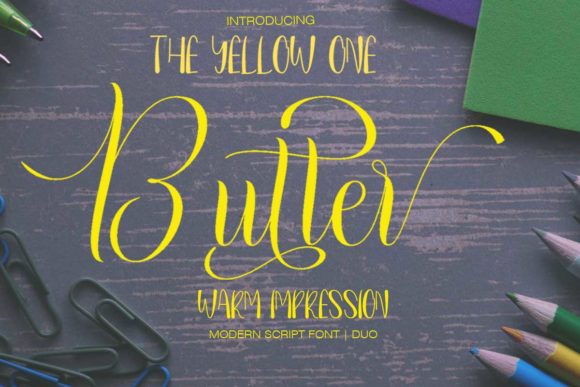
Butter: The Font Duo That Just Works
If you’ve ever spent 47 minutes scrolling through font libraries—tweaking letter spacing, testing contrast, second-guessing whether “playful” reads as “unprofessional” on a business card—you’ll recognize the quiet relief of finding Butter. It’s not another flashy display font that looks amazing in a mockup and collapses under real-world use. Butter is a thoughtfully paired script and sans-serif duo designed to do what fonts should: support your message, not compete with it.
What Butter Actually Is (and Why That Matters)
Butter isn’t one font—it’s two intentionally matched typefaces: a warm, confident script and a clean, grounded sans-serif. They share rhythm, x-height, and subtle design DNA, so they pair without friction. No awkward sizing gymnastics. No “why does this feel off?” moments when you switch from headline to body text. You get consistency across voice: the script carries personality; the sans brings clarity. Together, they behave like a team—not a compromise.
Where Butter Fits Into Real Life (Not Just Design Theory)
You don’t need to be a graphic designer to benefit from Butter. You just need to communicate—and often, quickly.
For the Small Business Owner Building Their First Brand
Think of Maya, who launched a ceramic studio from her garage last spring. She made beautiful mugs, wrote heartfelt Instagram captions, and needed packaging that felt handmade but trustworthy. She used Butter’s script for her logo and product tags (“Hand-thrown in Portland”), then switched to the sans for care instructions and website copy. Customers told her the labels “felt like they were written just for them”—not because of magic, but because the script had warmth and the sans had legibility. No extra design hire. No overthinking. Just butter, applied.
For the Educator Creating Classroom Materials
Mr. Lee teaches 6th grade science and spends hours each week designing handouts, slide decks, and lab instructions. He tried Butter for a unit on ecosystems—using the script for section headers (“Meet the Decomposers!”) and the sans for bullet points, definitions, and safety notes. Students responded better to the visual hierarchy: the script signaled “this is where we lean in,” while the sans kept facts scannable. He didn’t change content—just how it landed. And yes, he downloaded the free trial version first, tested it in Google Slides and Canva, and only upgraded after confirming it rendered cleanly on student Chromebooks.
For the Blogger or Newsletter Writer
When Sarah redesigned her weekly gardening newsletter, she wanted to keep her friendly tone but add polish. She swapped her generic serif for Butter’s sans in body text—it improved readability on mobile without sacrificing character. Then she used the script sparingly: only in the subject line preview (“🌱 This week: Your soil test decoded”) and the closing signature. Subscribers clicked 12% more on that issue. Not because the font “converted”—but because it made the email feel human, intentional, and easy to move through.
For the Freelancer Pitching Clients
Freelancers often send PDF proposals that vanish into inboxes. Alex, a UX writer, started using Butter in his pitch decks: script for project titles (“Let’s simplify your onboarding flow”), sans for timelines, deliverables, and pricing tables. The contrast subtly signaled confidence—not flashiness. One client told him, “Your deck didn’t feel like a sales pitch. It felt like a conversation.” That’s the script’s authenticity meeting the sans’s reliability. No jargon required.
What to Consider Before You Use Butter
It’s versatile—but not universal. Here’s what helps it land well:
- Licensing matters. Butter offers personal, commercial, and extended licenses. If you’re using it in a client’s logo or a Shopify theme you sell, double-check the license tier. Free trials are great for testing—but not for shipping final files.
- Context shapes impact. Butter’s script shines at medium-to-large sizes (think headlines, quotes, signage). At 10pt in dense body copy? It loses its charm. Reserve it for moments where personality earns attention—not competes with comprehension.
- Pairing is built-in—but not automatic. Even with perfect rhythm, contrast in weight and size still matters. Try setting the script at 36pt and the sans at 18–20pt for web headers. In print, increase the sans leading slightly to balance the script’s vertical energy.
- Test where people actually see it. Butter renders beautifully in Figma and Adobe apps—but check how it appears in Gmail, Notion, or Canva exports. Some platforms substitute fonts if embedding fails. When in doubt, outline text for static PDFs or use web-safe fallbacks for live sites.
Who Gets the Most Out of Butter (and Why)
It’s especially helpful for people who wear multiple hats: the café owner designing their own menu, the nonprofit staffer making social graphics, the teacher prepping distance-learning slides, the podcaster building a brand kit. These aren’t full-time designers—they’re doers who need tools that respect their time and intention. Butter doesn’t ask you to learn kerning rules or study typographic history. It asks you to choose where warmth ends and clarity begins—and gives you both, in one download.
That said, it’s not ideal for every scenario. Legal disclaimers? Technical documentation? Multilingual interfaces with complex scripts? Those demand neutrality, not personality. Butter excels where voice matters: storytelling, branding, invitations, learning materials, small-batch products, personal websites. It’s for when “what you say” and “how it feels to read it” carry equal weight.
A Practical Starting Point
Don’t over-engineer your first use. Pick one place where typography currently feels flat or inconsistent—a landing page headline, a workshop handout title, the name on your business card—and try Butter there. Use the script for the short, evocative phrase. Use the sans for everything else. See how it changes the breathing room. Notice whether people pause longer—or comment on the tone. That’s not luck. That’s intentional design, made accessible.
At its core, Butter works because it understands a simple truth: good typography isn’t about standing out. It’s about helping people stay—stay engaged, stay clear, stay connected to what matters. Whether you’re launching a side hustle or preparing a classroom lesson, that’s not a luxury. It’s the baseline.