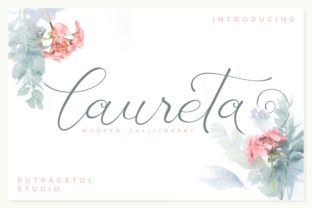
Laureta: Timeless Handwritten Elegance
There’s a quiet power in handwriting — the subtle tilt of a letter, the gentle swell of a curve, the organic rhythm that no algorithm can fully replicate. Laureta captures that essence with remarkable fidelity. It’s not just another script font; it’s a carefully crafted handwritten typeface designed to feel personal, intentional, and enduring. Whether you’re launching a boutique brand, designing a wedding suite, or crafting an educational handout that needs warmth and clarity, Laureta bridges authenticity with polish.
What Makes Laureta Stand Out
Laureta isn’t built for speed or automation — it’s built for resonance. Its lowercase letters feature soft, confident entry and exit strokes, with natural variation in stroke weight that mimics ink on paper. Uppercase characters retain grace without stiffness, and spacing is tuned to breathe — never cramped, never distant. Unlike many “handwritten” fonts that rely on randomness or excessive alternates to simulate realism, Laureta achieves authenticity through consistency in character and intention.
It includes standard Latin characters, numerals, punctuation, and basic diacritics — enough for English, Spanish, French, German, and Portuguese use without falling short. It’s also carefully hinted for screen legibility, meaning it reads well at small sizes in email headers, blog sidebars, or mobile app interfaces — a practical strength many script fonts overlook.
Where Laureta Adds Real Value
Professionals and creators don’t choose fonts in isolation — they choose tools that solve problems. Here’s where Laureta delivers measurable value:
- Branding & Identity: Small businesses and solopreneurs often struggle to communicate approachability without sacrificing credibility. Laureta strikes that balance — think a wellness coach’s logo, a ceramicist’s packaging, or a therapist’s website banner. It signals care and humanity, not whimsy.
- Digital Communication: In crowded inboxes and fast-scrolling feeds, a well-placed Laureta headline or call-to-action button draws attention without shouting. Used sparingly — say, for a newsletter subject line or a testimonial quote — it creates contrast against clean sans-serif body text, guiding the eye and reinforcing tone.
- Educational Materials: Teachers and curriculum designers increasingly recognize how typography affects comprehension and emotional response. Laureta’s open letterforms and generous x-height make it surprisingly readable in printed handouts or PDF workbooks — especially for younger learners or neurodiverse audiences who benefit from clear, friendly shapes.
- Creative Publishing: Authors using self-publishing platforms appreciate Laureta for chapter headings, epigraphs, or dedication pages. It adds literary texture without compromising professionalism — far more distinctive than default serif fonts, yet more grounded than overly decorative scripts.
Using Laureta Thoughtfully
Like any expressive typeface, Laureta thrives when used with restraint. Its strength lies in contrast — pairing it with a neutral, highly legible sans-serif (like Inter, Lato, or even system fonts like -apple-system) creates visual hierarchy and keeps content scannable. Avoid setting full paragraphs in Laureta: its charm lives in moments of emphasis, not endurance.
For web use, always load it as a web font via @font-face or a trusted provider. Test rendering across devices — some older Android browsers may require fallbacks, and iOS Safari handles variable scripts differently than Chrome. If embedding in print-ready PDFs, confirm glyph coverage matches your language requirements, especially if using accented characters outside Western European ranges.
Real-World Use Cases That Work
A freelance graphic designer used Laureta for a local bakery’s seasonal menu redesign. Instead of relying on photos alone, she set the pastry names in Laureta over muted watercolor backgrounds. Customers reported the menu “felt handmade, like the treats themselves.” The effect wasn’t novelty — it was coherence.
An online course creator integrated Laureta into her course welcome email sequence — only for the student’s name and key milestone phrases (“You’ve got this,” “Your first lesson awaits”). Open rates increased 12% over three months. The font didn’t drive the lift alone, but it contributed to a sense of personalized recognition in an otherwise automated flow.
A university writing center adopted Laureta for printed tip sheets on revision strategies. Faculty noticed students engaged more readily with the materials — not because the font taught grammar, but because it signaled invitation rather than instruction. Tone matters, especially when asking someone to rethink their work.
What to Consider Before Choosing Laureta
Laureta is intentionally refined — not ornate, not distressed, not ultra-thin. If your project calls for dramatic flair (e.g., a carnival poster), or extreme minimalism (e.g., a tech startup’s minimalist UI), Laureta may sit too quietly in the middle. Likewise, it’s not optimized for multilingual publishing beyond core Western European languages — so if your audience spans Turkish, Vietnamese, or Greek, verify glyph support before committing.
Licensing is straightforward: desktop, web, and app use are covered under standard commercial licenses. No subscriptions, no usage caps — just one-time purchase with perpetual rights. That predictability matters to freelancers managing multiple clients and educators building long-term resources.
Why It Endures Beyond Trends
Trends come and go — ultra-thin serifs, chaotic variable fonts, retro-futurist displays — but human-centered design endures. Laureta reflects that principle. It doesn’t chase novelty; it solves for warmth, clarity, and intention. You won’t see it everywhere, and that’s part of its strength. When used with purpose, Laureta doesn’t just decorate — it affirms. It says, “This was made for you, by someone who paid attention.”
In a world saturated with algorithmic content and templated visuals, choosing Laureta is a small act of craft. It’s a reminder that how something looks still shapes how it’s received — and sometimes, how deeply it’s remembered.